

(The article was originally published in Indian Express as a part of Dr Ram Madhav’s column titled Ram Rajya on May 30, 2026. Views expressed are personal.)
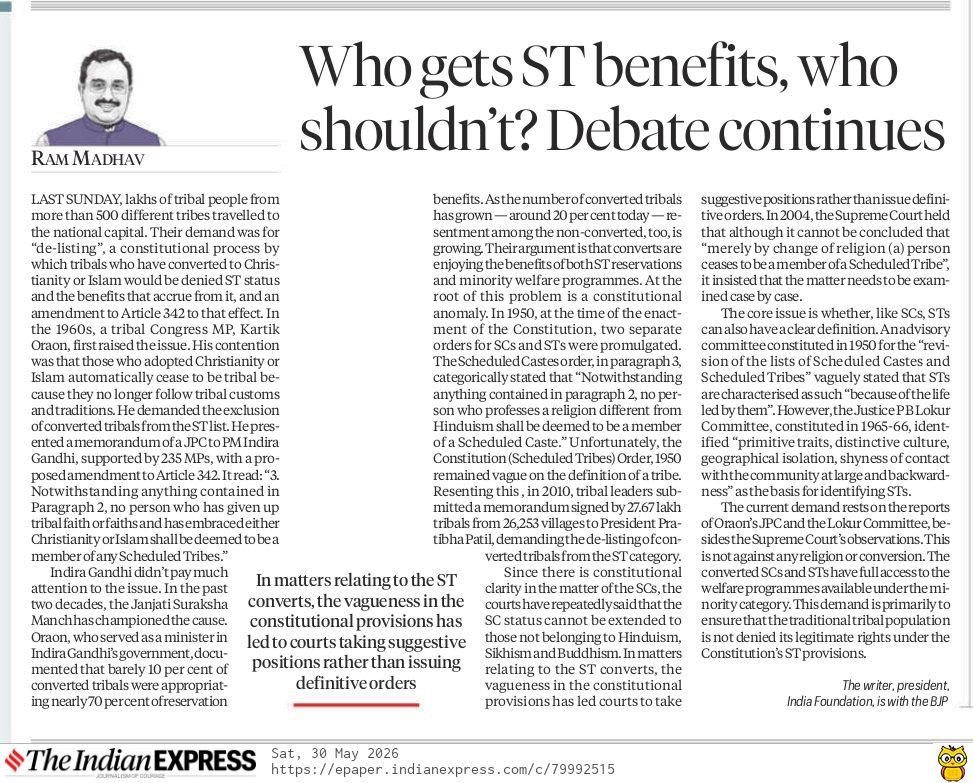
Last Sunday, Delhi witnessed a massive congregation of tribals who came from all over the country to commemorate the 150th birth anniversary of a renowned freedom fighter of tribal origin, Birsa Munda. Over two lakh tribals from more than 500 different tribes descended on the national capital demanding “de-listing”, a constitutional process by which the tribals who converted to Christianity or Islam would be denied ST status and benefits that accrue thereof. Towards that end, the organisers demanded an amendment to Art 342 of the Indian Constitution that would disqualify converted tribals from enjoying the benefits of ST Act provisions like reservations etc.
This sensitive issue has been in tribal discourse for more than six decades. In 1960s, a tribal MP from what now became Jharkhand by name Kartik Oraon, representing the ruling Congress Party, had raised the issue for the first time. Oraon’s contention was that those tribal people, who adopted Christianity or Islam, automatically cease to be tribal because they no longer follow their respective traditions. Oraon demanded exclusion of converted tribals from the authentic list of Scheduled Tribes. He presented a memorandum of the Joint Parliamentary Committee to prime minister Indira Gandhi supported by 235 Members of Parliament with the proposed amendment to Art 342, which read: “3. Notwithstanding anything contained in Paragraph 2, no person who has given up tribal faith or faiths and has embraced either Christianity or Islam shall be deemed to be a member of any Scheduled Tribes”.
Unfortunately, Indira didn’t pay much attention to it and the issue lingered on. In the last two decades, Janjati Suraksha Manch, a tribal body committed to the preservation of culture and traditions of the tribals in the country, championed the cause left behind by Kartik Oraon. The Delhi rally of the tribals was also organised by the Manch only. Oraon, who was one of the very few tribals studied abroad, served as a minister in Indira Gandhi’s government. He studied the complex issue and documented that barely 10% converted tribals were appropriating nearly 70% of reservation benefits, leaving only 30% for the remaining genuinely poor and traditional 90% tribal population. Over the last several decades, numbers of converted tribals have increased and estimated at around 20 percent today. There is a growing resentment among the non-converted that the converted tribals are enjoying the benefits of both ST reservations and minority welfare programs.
At the root of this problem is a major constitutional anomaly. The British had promulgated the Government of India (Scheduled Castes) Order, 1936 based on the list of castes prepared by a census commissioner Dr J H Hutton, which categorically declared in Paragraph 3 that Indian Christians would not be deemed to be members of the Scheduled Castes.
In 1950, at the time of the enactment of the Indian Constitution, two separate Orders for Scheduled Castes and Scheduled Tribes were promulgated. The Scheduled Castes order, in Paragraph 3, following the 1936 Order, categorically stated that “Notwithstanding anything contained in Paragraph 2, no person who professes a religion different from Hinduism shall be deemed to be a member of a Scheduled Caste”. Unfortunately, the Constitution (Scheduled Tribes) Order, 1950, promulgated around the same time, remained vague on the question of the definition of a tribal. That vagueness is leading to resentment among a large section of the tribals. Earlier, in 2010, senior tribal leaders called on the President of India, Smt. Pratibha Patil, and submitted a memorandum signed by 27.67 lakh tribals from 26,253 villages across the country demanding de-listing of converted tribals from the ST category.
Questions relating to SC and ST converts went to the Supreme Court several times. Since there existed constitutional clarity in the matter of the SCs, the courts have repeatedly said that the SC status cannot be extended to those not belonging to Hinduism, Sikhism and Buddhism (as per the amendment to the SC Act in 1956). Whereas in matters relating to the ST converts, vagueness in the constitutional provisions led to courts taking suggestive positions rather than definitive orders. In an important judgement in 2004, the Supreme Court held that although it cannot be concluded that “merely by change of religion (a) person ceases to be a member of scheduled tribe”, it insisted that the matter needs to be examined on a case-to-case basis. “In such a situation, it has to be established that a person who has embraced another religion is still… following the customs and tradition of the community, which he earlier belonged to”, it proposed.
The core issue is whether, like the Scheduled Castes which have a clear definition as belonging to Hinduism, Sikhism and Buddhism, the Scheduled Tribes too can have a clear definition. An Advisory Committee constituted by Government of India in 1950 for the “revision of the lists of scheduled castes and scheduled tribes” argued that while non-Hindus cannot be included in SC list, “Scheduled Tribes may belong to any religion”. It vaguely defined that they are categorised as STs “because of life led by them”. However, the Lokur Committee, headed by Justice P. B. Lokur,constituted in 1965-66 for identifying and listing Scheduled Tribes (STs) provided a broader definition. It identified “primitive traits, distinctive culture, geographical isolation, shyness of contact with community at large and backwardness” as the basis for identifying Scheduled Tribes.
Current demand of the tribal bodies rests on the Lokur Committee and Kartik Oraon’s Joint Parliamentary Committee reports besides the Supreme Court observations and insists on identifying Scheduled Tribes as those with a traditional faith, culture, customs, rituals, and practices. Those converting to other religions abandon most of these and hence be de-listed, the argument goes. This is not against any religion or conversion. The converted SCs and STs have full access to the welfare programs available under minority category. This demand is primarily to ensure that the traditional tribal population is not denied of its legitimate rights over the ST provisions under the Indian Constitution and their distinctive cultural and religious identity is protected.