

(The article was originally published in Indian Express as a part of Dr Ram Madhav’s column titled Ram Rajya on June 06, 2026. Views expressed are personal.)
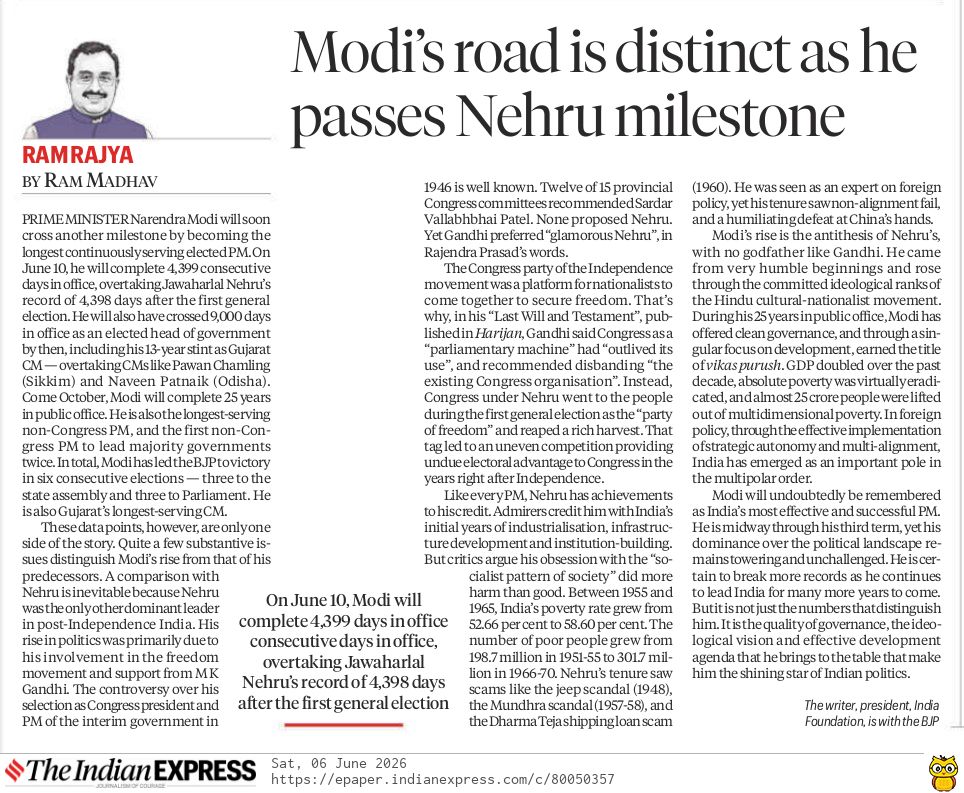
Prime minister Narendra Modi will soon be crossing an important milestone in his own political career and also in country’s post-independence history by becoming the longest continuously serving elected prime minister of India. On June 10, Modi would be completing 4399 days in office uninterruptedly as prime minister overtaking Jawaharlal Nehru’s record of 4398 days. He would also have crossed 9000 days in office as an elected head of government by then, that includes his 13-year stint as the chief minister of Gujarat. This again is a rare feat as he overtakes chief ministers like Pawan Chamling (Sikkim) and Naveen Patnaik (Orissa) who served in public office for over 24 years. Come October, Modi would be completing 25 years in public office.
He has several other firsts to his credit. He is the longest serving non-Congress prime minister of the country, and equalled Nehru’s record of winning three consecutive parliament elections. He is also the first prime minister to have been born after independence and the first non-Congress prime minister to run full majority governments twice – in 2014 and 2019. In total, Modi led his party, the BJP, to victory in six consecutive elections – three assembly and three parliament. He also had to his credit the record of longest serving chief minister of Gujarat for almost 13 years from 2001 to 2014.
However, these data points are only one side of the story. There are quite a few substantive issues that distinguish Modi’s rise from that of his predecessors. Nehru’s rise in Indian politics was primarily due to his involvement in the freedom movement and the support he got from M K Gandhi. Comparison with Nehru is not liked by some but it becomes inevitable because Nehru was the only other dominant leader in post-independence India. Nehru was born with the proverbial silver spoon. The controversy over his selection as the Congress president and subsequently the prime minister of the interim government in 1946 is well-known. When elections to the post of Congress President were announced with April 29, 1946, as the last date for nominations, twelve out of the fifteen state/regional Congress committees, which were authorised by the Congress Constitution to nominate the president, recommended Sardar Patel’s name. None proposed Nehru for the post. Yet, Gandhi preferred “glamorous Nehru”, in Rajendra Prasad’s words, for that post.
More importantly, Congress of the independence movement was a platform for all nationalists to come together on the common agenda of securing freedom for the country. That’s why even Gandhi wished that it should be disbanded after independence. In his “Last Will and Testament”, published in Harijan, Gandhi clearly stated that Congress as a “parliamentary machine has outlived its use” and recommended to “disband the existing Congress organisation”. Gandhi met with untimely death soon after and his last will was never implemented. Instead, Congress under Nehru’s leadership went to the people during the first general election in 1952 in the garb of the “party of freedom” and reaped rich harvest. That tag led to an uneven competition providing undue electoral advantage to the Congress during those post-independence years.
It was not any ideology or vision that catapulted Nehru to the dominant position. If he indeed followed any ideology, it was Socialism, which his mentor Gandhi publicly despised. Every prime minister had things to his credit, so was Nehru. Admirers credit him with India’s initial years of industrialisation, infrastructure development and institution building. But critics argue that his obsession with “socialist pattern of society”, together with his statistician-turned-economist friend P C Mahalanobis, had done greater harm to the country than good. If data were to be flaunted as evidence, between 1955 and 1965, India’s poverty rate grew from 52.66% to 58.60%. In absolute numbers, it meant that the number of poor people in India grew from 198.7 million in 1955 to 301.7 million in 1965. Nehru’s tenure also saw several scams like the Jeep Scandal (1948), Mundhra Scandal (1957-58), Dharma Teja Shipping Loan scam (1960) etc.
Nehru was regarded as an expert on foreign policy. Yet, his years saw the much-touted non-alignment failing to take off and India facing a humiliating defeat at the hands of China and losing a huge chunk of its sovereign territory.
Modi’s rise in the Indian politics is just the anti-thesis to that of Nehru. Modi had no godfather like Gandhi to promote him. Unlike Nehru, he came from very humble beginnings. He rose through the committed ideological ranks of the Hindu cultural nationalist movement through hard work and dedication. He is an example for Gandhi’s definition of true democracy – Ram Rajya – where “the weakest shall have as much power as the strongest”. During his 25 years of public office, Modi offered a clean and corruption-free government and through singular focus on development, acquired the title of “Vikas Purush”. He not only presented an ideological vision but brought it from the fringes of Indian polity to occupy national centre-stage today.
Modi proved more successful in managing Indian economy and foreign policy than Nehru and others. India’s GDP doubled in last one decade. Absolute poverty was completely eradicated, and 25 crore people were brought out of multidimensional poverty. In foreign policy, Modi scripted a glorious history. Effective implementation of strategic autonomy and multi-alignment by his government became a model for several countries to emulated. India emerged as an important pole in the multipolar global order enjoying great respect from different world powers.
Modi, undoubtedly, will be remembered as the most effective and successful prime minister of India. He is midway through his third term as the prime minister. Yet, his dominance over Indian political landscape remains towering and unchallenged. He is certain to break more records as he continues to lead the country for many more years to come.
But it is not just the numbers that distinguish Modi from others. It is the quality of governance, ideological vision and effective development agenda that he brought to the table as the leader of the world’s largest democracy that makes him the shining star of Indian politics.