

(The article was originally published in Indian Express as a part of Dr Ram Madhav’s column titled Ram Rajya on May 09, 2026. Views expressed are personal.)
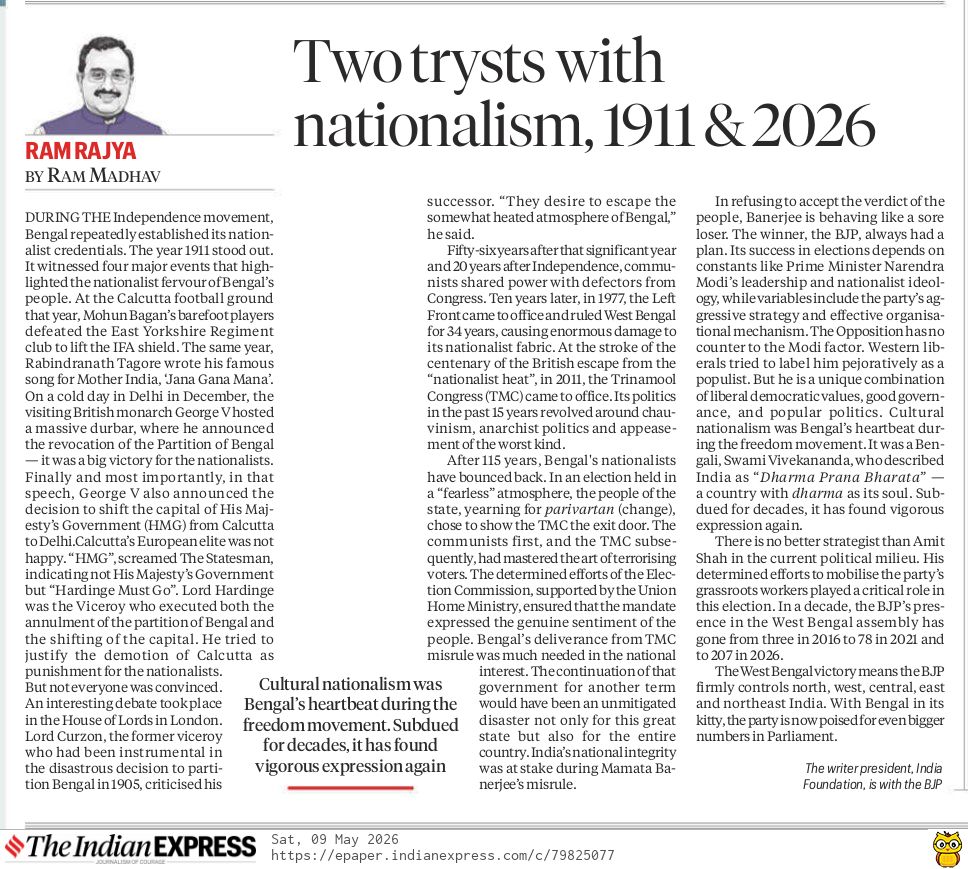
Bengal was once the hotbed of nationalists. It produced great reformers and patriots like Raja Rammohan Roy, Bankim Chandra Chattarjee, Swami Vivekananda, Rishi Aurobindo, Rabindranath Tagore and Shyama Prasad Mukharjee. Its nationalist credentials were established repeatedly during the independence movement. One year that significantly stood out was 1911, which witnessed four major events highlighting the nationalist fervour of the people of Bengal. At the Calcutta football ground that year, the bare-footed local boys, running the football club called Mohun Bagan, defeated the East Yorkshire Regiment Club team of British Sahibs for the first time to triumphantly lift the IFA shield.
It was in the same year that Gurudev Rabindranath Tagore penned his famous patriotic song for Mother India, Jana Gana Mana, stirring up millions of minds with nationalist fervour. Thirdly, on a cold winter day in Delhi in the second week of December that year, visiting British emperor King George V hosted a massive Durbar attended by nearly a lakh people and announced the revocation of the 1905 decision of partition of Bengal, a humungous victory for the nationalists and their Vande Mataram movement. Finally, and most importantly, in that same speech the emperor also announced the decision of shifting the capital of His Majesty’s Government (HMG) from Calcutta to Delhi.
Not all were happy, not definitely the European elite in Calcutta. “HMG” screamed The Statesman Daily indicating not His Majesty’s Government but “Hardinge Must Go”. Lord Hardinge was the Viceroy who executed both the decisions – annulment of partition of Bengal and shifting of capital to Delhi. Hardinge tried to justify that demotion of Calcutta from the national capital to a provincial one was intended to be a punishment to the nationalists who perpetually stood opposed to the British rule. But not all were convinced. An interesting debate took place in the House of Lords in London on the issue of shifting of capital. Lord Curzon, who served as the British Viceroy earlier in Calcutta and who was instrumental in the disastrous decision of partitioning of Bengal in 1905 with a view to weakening the nationalist forces in the state, was there in the House to strongly denounce the decision of his successor. “They desire to escape the somewhat heated atmosphere of Bengal”, he complained.
Fifty-five years after that significant year and twenty years after independence, “heated Bengal” of the nationalists fell into the hands of the Communists in 1967. They ruled over the state for 44 years causing enormous damage to the once-prided nationalist fabric of the state. Then, at the stroke of the centenary of the British escape from the “nationalist heat”, Bengal fell to the regionalist Trinamool Congress (TMC) Party in 2011, whose politics in the last fifteen years revolved round dangerous chauvinism, anarchist politics and appeasement of worst kind almost tantamount to anti-nationalism.
Finally, after 115 years, the nationalists of Bengal bounced back. In an election held after several decades in a truly “fearless” atmosphere, people of the state, who were silently yearning for “Parivartan”, chose to show the incumbent government the exit door. Fearless election was the key, because the Communists initially, and Mamata’s party subsequently, mastered the art of terrorising voters into submitting to their will while voting. Who would vote, and who would not, used to be decided by the goons of the ruling party in many villages. Thanks to the determined efforts of the Election Commission, supported by Union Home Ministry, the elections were conducted without fear, and the genuine sentiment of the people manifested through the mandate. Bengal’s deliverance from TMC misrule was much needed in the national interest. Continuance of that government for one more term would have been an unmitigated disaster not only for the future of that great state but also for the entire country. India’s national integrity was at stake under the misrule of Mamata Benarjee. It became a refuge and playground for all types of anti-national forces from illegal infiltrators to anti-India urban Naxals.
It is said that losers always have an excuse while winners always have a plan. In refusing to accept the verdict of the people, Mamata is behaving like a real loser. The winner, BJP, always had a plan. The BJP’s success in any election depends on certain constants, like the leadership of prime minister Narendra Modi and the cultural nationalist ideology it espouses, while the variables that play a key role in securing victories include its aggressive strategy and effective organisational mechanism. Modi factor is a major constant for which the opposition has no counter. Western liberals tried to label him pejoratively as populist. But he is a unique combination of liberal democratic values, good governance, and popular politics, something unknown to modern political scientists. Cultural nationalism was the heartbeat of Bengal during the freedom movement. Subdued for decades, it now found its vigorous expression once again. It was a Bengali, Swami Vivekananda, who described India as “Dharma Prana Bharata” – country with Dharma as the soul. Only party that represented that soul in India is the BJP and that’s why it dominates Indian political landscape today.
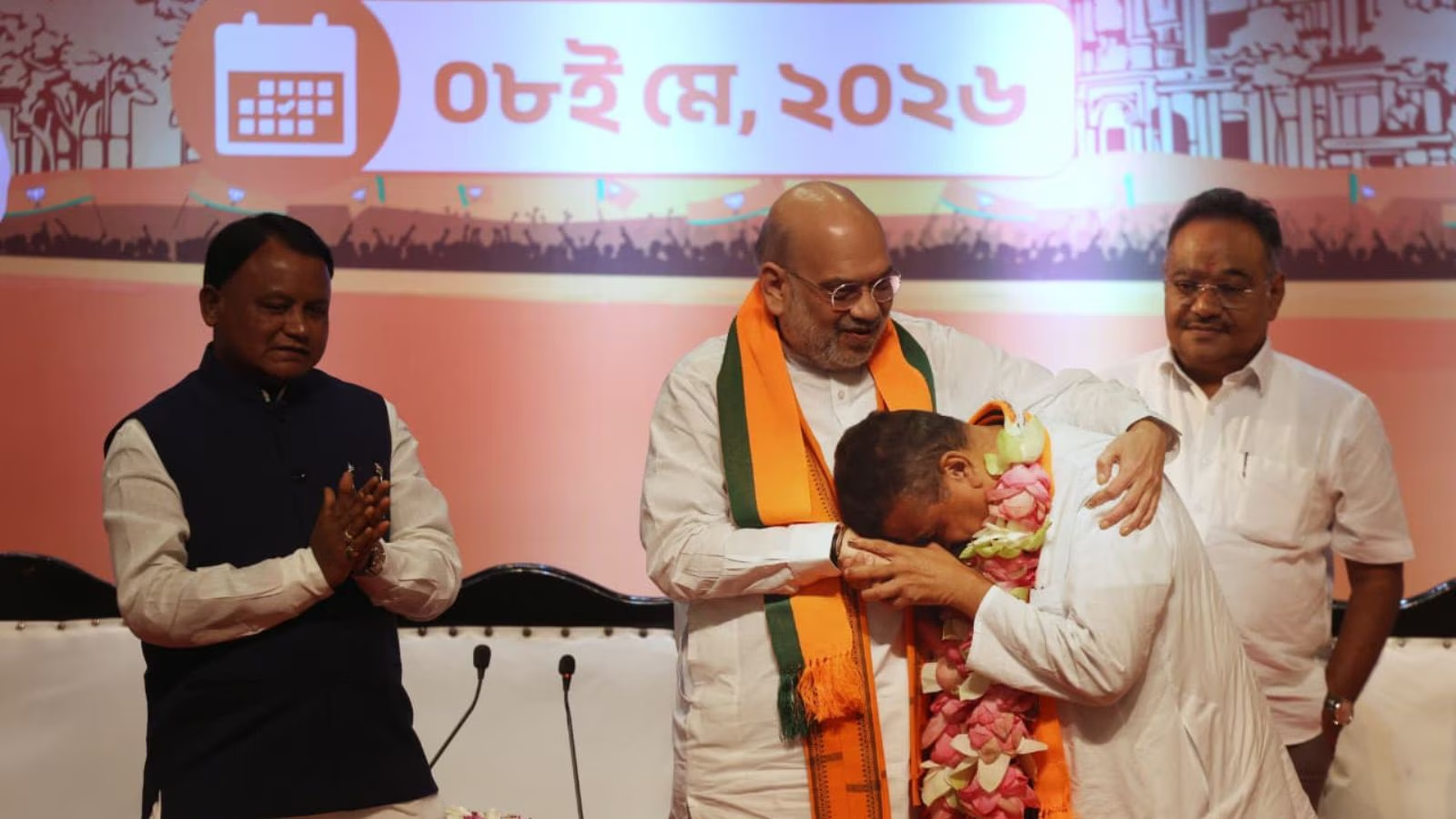
There is no better strategist than Amit Shah in the present political milieu. His determined efforts, together with his organisational colleagues, at mobilising grassroots party network in an effective and aggressive manner, played the most critical role in this election. In a decade’s time, Shah took BJP in Bengal from a 3-member legislature party in 2016 to a 78-member one in 2021 and to a 207-member ruling party in 2026. The opposition has hardly an organiser of Shah’s calibre and killer instinct to combat the BJP.
Victory in Bengal is a major feather in BJP’s cap. It now firmly controls North, West, Central, East and Northeast India. Congress under Rahul Gandhi’s leadership became like a regional party confined to a couple of states in South India. Next few years will see the BJP turning its attention to that region too. With Bengal in its kitty, the party is now poised for bigger numbers in the parliament in future.