

(The article was originally published in Indian Express as a part of Dr Ram Madhav’s column titled Ram Rajya on April 25, 2026. Views expressed are personal.)
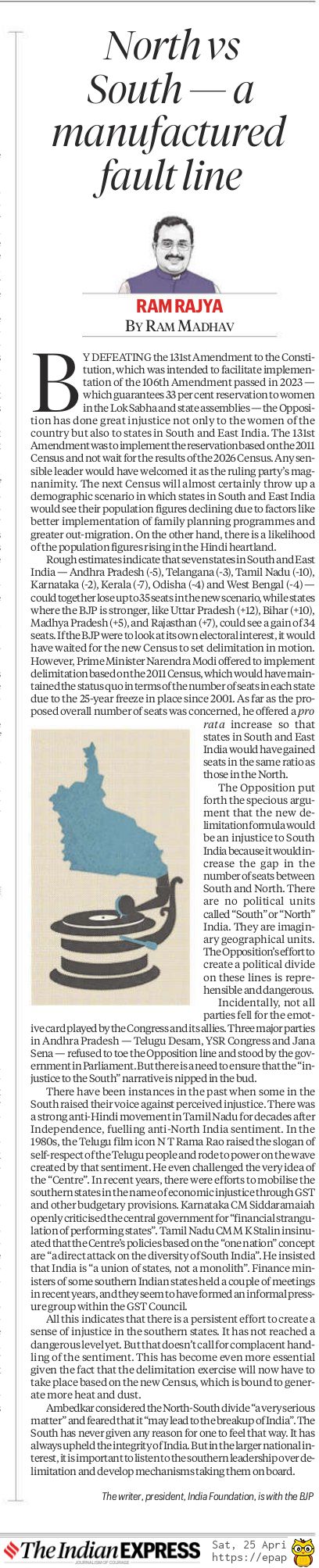
By defeating the 131st Amendment to the Indian Constitution that was intended to facilitate implementation of the 106th Amendment passed in 2023 guaranteeing 33 percent reservation to women in the Lok Sabha and state assemblies, the opposition parties have done great injustice not only to the women of the country but also to a number of states, especially in South and East India. The 131st Amendment was to affect an important change to the 106th Amendment by way of not waiting for the 2026 census data for delimitation and reservation but implementing the same based on the 2011 census data. Any sensible leader would have welcomed it as the ruling party’s magnanimity. The next census, whenever it happens, would certainly through up a much changed demographic scenario of the country in which certain states, mostly in South and East India, would see their population figures declining due to factors like better implementation of family planning programs and also, in case of states like Kerala, a greater amount of out-migration. On the other hand, there is a likelihood of population figures going up in the Hindi heartland states.
Rough estimates indicate that seven states in South and East India – Andhra Pradesh (-5 seats), Telangana (-3 seats), Tamil Nadu (-10 seats), Karnataka (-2 seats), Kerala (-7 seats), Orissa (-4 seats) and West Bengal (-4 seats) – could together lose 35 seats in total in the new scenario while the Hindi heartland states, where the BJP is stronger – Uttar Pradesh (+12 seats), Bihar (+10 seats), Madhya Pradesh (+5 seats), and Rajasthan (+7 seats) – could gain 34 seats. If the ruling BJP were to look for its own electoral interest it would have waited for the new census to set the delimitation in motion. However, prime minister Narendra Modi offered to implement delimitation based on 2011 census, which would have maintained status quo in terms of number of seats in each state due to the 25-year freeze in place since 2001. He also offered to provide prorata increase in the number of seats in each state so that no injustice was done to any of them. That meant that states in South and East India, where the BJP is not a strong contender, would have gained seats in same ratio as the states in the North where the party has strong electoral presence.
By rejecting the amendment, the Opposition demonstrated that its leadership lacked vision and maturity. It sought to invoke a fictitious bogey that the new delimitation formula would do injustice to South India because it will increase the gap in number of seats between South and North. This is a facetious argument. There are no such political units called South and North India. They are just imaginary geographical units. South comprises of states where the BJP and allies have considerable presence like Andhra Pradesh and Karnataka while the North has states ruled by the Opposition parties like Jammu & Kashmir, Punjab, and Himachal. The opposition’s effort to create a political divide between the South and the North is not only reprehensible but dangerous too.
Incidentally, not all parties fell for the emotive card played by the Congress and its allies like DMK and the Left Parties. Three major parties in Andhra Pradesh – the Telugu Desam Party, the YSR Congress Party and the Jana Sena Party – refused to toe the opposition line and stood by the government in the parliament during last week’s voting. That may be a solace for the ruling establishment. But there is a need to ensure that the “injustice to South” narrative set in motion by the opposition is nipped in the bud. It is not enough to highlight about the injustice done by the opposition to the women. It is also important to reassure the South that no injustice is being done to it.
There have been instances in the past when some in the South felt treated unjustly and raised their voice. There was a strong anti-Hindi movement in Tamil Nadu for decades after independence fuelling anti-North India sentiment. In 1980s, the Telugu film icon N T Rama Rao raised the slogan of self-respect of Telugu people and rode to power over the wave created on that sentiment. He even challenged the very idea of a central government and called the “centre” a “myth”. In recent years, there were efforts to mobilise the Southern states in the name of economic injustice through GST and other budgetary provisions. Siddaramaiah, chief minister of Karnataka openly criticised the central government for “financial strangulation of performing states”. M K Stalin, chief minister of Tamil Nadu insinuated that centre’s policies based on “one nation” concept are “a direct attack on the diversity of South India”. He insisted that India is “a union of states, not a monolith”. A couple of meetings of the finance ministers of South Indian states took place in recent years and they seem to have formed an informal pressure group in the GST Council too.
All this indicates that there is a deliberate attempt to foment sentiment in the Southern states over imagined injustice. It did not reach danger level yet. It may never reach there too. But that doesn’t call for complacent handling of the sentiment. This has become even more essential due to the unthoughtful action of the opposition in defeating delimitation bill. The exercise will now have to take place based on the new census which is bound to generate more heat and dust.
The South always upheld the integrity of India. It is important now that the Southern leadership is engaged more constructively in the dialogue over delimitation.