

(The article was originally published in Indian Express as a part of Dr Ram Madhav’s column titled Ram Rajya on November 28, 2026. Views expressed are personal.)

In the Raja Mandala theory of Arthashastra, Kautilya surmised that neighbours can be both friends and foes. He advocated for the Shadgunya Niti, a six-pronged strategy to deal with them, involving friendship and alliance when possible, patience when required, and toughness when necessary. No other relationship that India shares with its neighbours has passed through all these phases quite like its relationship with Nepal. This relationship, which all successive governments on both sides have described as “age-old, civilisational” has witnessed several ups and downs over the last seven-plus decades. Ultimately, however, what prevailed was a natural bond of emotional oneness – a feeling of brotherly affinity that has helped the two countries overcome strains on many occasions.
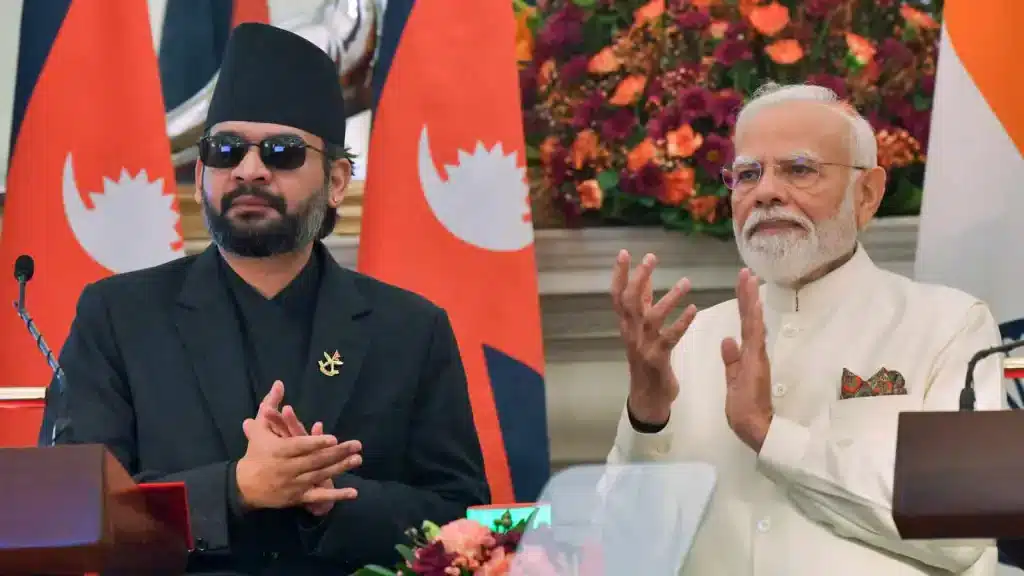
The visit of Balen Shah, Prime Minister of Nepal, to New Delhi earlier this week – although a short one – proved once again that the bilateral relationship is based not just on agreements and treaties, but on mutual goodwill and natural affinity. After becoming Prime Minister in March this year, Shah took his own sweet time before engaging in diplomatic ventures, initially declining to meet with foreign dignitaries. He took time to meet the Indian Ambassador and India’s Foreign Secretary. Although this raised eyebrows, one could eventually appreciate that the Prime Minister, being new to the national role, wanted time to understand the complex dynamics of his country’s relationships with its immediate neighbours.
As Prime Minister Shah’s visit to India faced delays, strategic circles in India kept their fingers crossed, recalling his earlier nationalist stance on border issues when he was the Mayor of Kathmandu. On its part, India conveyed its desire for a cordial bilateral relationship by extending an invitation to the Prime Minister to visit New Delhi. When Rabi Lamichhane, a senior minister and leader of the ruling party, visited India in July this year, he received warm hospitality.
Given this background, the 25-hour visit of Prime Minister Shah turned out to be a successful one, helping to reset the relationship. His mature and positive demeanour helped remove any lingering apprehensions in Indian strategic circles.
For Prime Minister Modi, relationships with immediate neighbours, which he assiduously built from the day he assumed office by inviting all heads of state of those countries to his swearing-in, remain a top-of-the-agenda priority. Going beyond protocol, Modi held an hour-long one-on-one meeting with K. P. Oli when he visited New Delhi as Prime Minister in 2016. A similar meeting took place at Hyderabad House during Prime Minister Shah’s visit, where Modi spent close to two hours with his counterpart discussing various issues pertaining to the bilateral relationship. This generous, personalised approach – a trademark of Modi’s foreign policy – helped the leaders not only build a warm personal bond, but also exchange views frankly, unhindered by protocol, and resolve complicated issues. This time too, the lengthy meeting between the two prime ministers led to the release of a joint statement without the two sides having to sit across the table for formal negotiations.
This demonstrated the level of trust and confidence India has in its relationship with the Himalayan neighbour and its leader. Modi lavishly praised Shah for “his clear vision and unwavering commitment to the future of Nepal and to India-Nepal relations” and reminded him that the relationship between the two countries is “not merely one of neighbourhood, it is rooted in a deep sense of kinship and enduring trust”. Prime Minister Shah reciprocated the sentiment by calling India a “dependable and trusted neighbour” and described the bond between the two countries as being as tall as the Himalayas.
India’s relations with its Himalayan neighbours, such as Nepal and Bhutan, were shaped by the Cold War-era geopolitics of the 1950s. Those were also the tense years when Mao Zedong’s China extended its rule over Tibet, with Mao reportedly pursuing the “Five Fingers Policy”, which described Tibet as China’s right palm, and Ladakh, Nepal, Sikkim, Bhutan, and Arunachal Pradesh as its five fingers. With a view to helping each other protect their sovereign interests, India entered into bilateral treaties with Bhutan and Nepal in 1949 and 1950, respectively.
India conveyed its willingness to discuss all outstanding bilateral issues in the spirit of the treaty. It was decided during Shah’s visit that the foreign secretaries of both countries would soon initiate discussions on those issues.
Since the 1990s, India followed the “Neighbourhood First” principle, a policy Modi has vigorously pursued. However, he added an important dimension to it by insisting on the motto “Together We Grow”. India expects its neighbours to appreciate this spirit, which suggests that while foreign policy is the sovereign prerogative of every country, one nation’s decisions should help – not hinder – the interests of its neighbour.