

(The article was originally published in Indian Express as a part of Dr Ram Madhav’s column titled Ram Rajya on October 03, 2026. Views expressed are personal.)
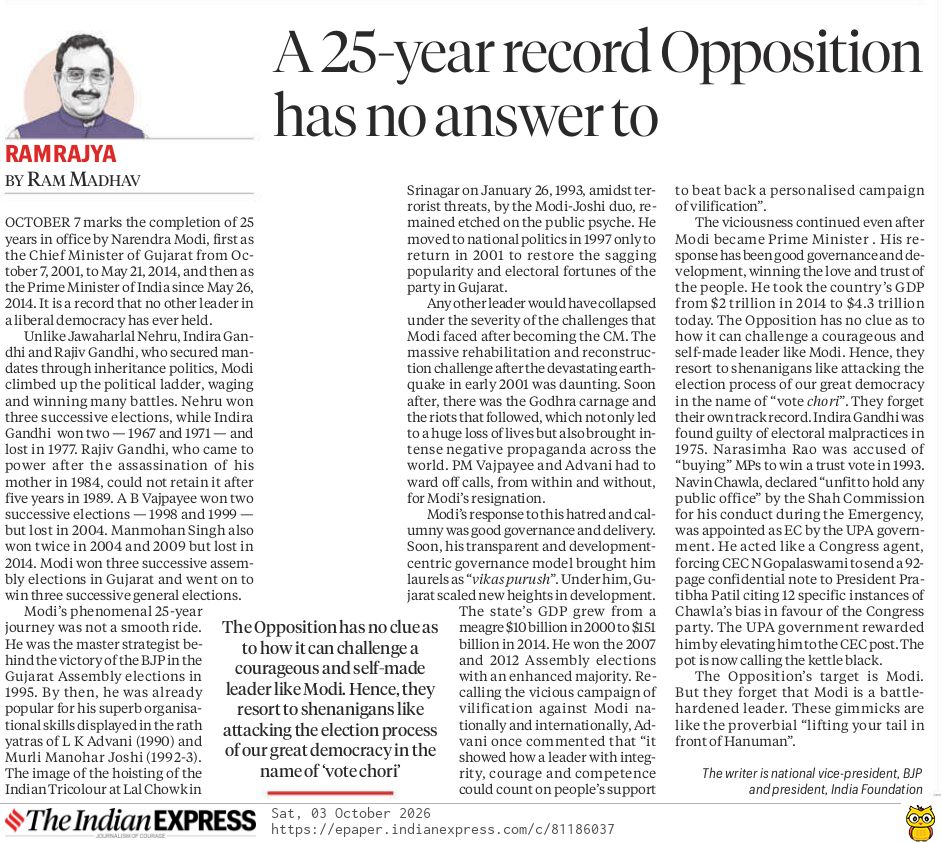
October 7 this year marks the completion of 25 years in office by prime minister Narendra Modi, first as the Chief Minister of Gujarat from October 7, 2001, to May 21, 2014, and as the Prime Minister of India since May 26, 2014. It is a record of sorts no other leader in liberal democracies had ever held. Leaders like Lee Kuan Yew of Singapore (31 years) in the last century did hold such a record so did others like Vladimir Putin of Russia (27+ years), Alexander Lukashenko of Belarus (31+ years) and Paul Kagame of Rwanda (26+ years). But those countries can hardly be compared with Indian democracy. Within the country, chief ministers like Pawan Chamling (Sikkim – 24 years 165 days), Naveen Patnaik (Orissa – 24 years 99 days), Jyoti Basu (West Bengal – 23 years 137 days), Gegong Apang (Arunachal Pradesh, 22 years 250 days), Lal Thanhawla (Mizoram, 22 years 60 days) and Manik Sarkar (Tripura, 20 years) held relatively longer tenures as heads of state. Modi overtook all those records.
Unlike leaders like Nehru, Indira and Rajiv who secured mandates through inheritance politics, Modi climbed up the political ladder as a grassroots leader waging and winning many political battles. Nehru won three successive elections in 1952, 1957 and 1962, while Indira won two – 1967 and 1971. Rajiv, who came to power after the assassination of his mother in 1984, could not retain it after five years in 1989. Vajpayee won two successive elections – 1998 and 1999 but lost in 2004. Same was the case with Manmohan Singh who won twice in 2004 and 2009 but lost in 2014. Contrast it with Modi, who won three successive assembly elections in Gujarat in 2002, 2007 and 2012, and went on to win three successive parliament elections thereafter – 2014, 2019, and 2024. Meanwhile, in his home state, the BJP continued its victory march winning assembly elections in 2017 and 2022 and creating the record of holding power for more than three decades since 1995.
This phenomenal 25-year journey of Modi was not a smooth ride. He had to withstand many a turmoil and overcome many a challenge. He was the master strategist behind the victory of the BJP in Gujarat Assembly elections in 1995. By then he was already popular across the country for his superb organisational skills in successfully organising the Rath Yatras of Advani (1990) and Murli Manohar Joshi (1992-3). The image of hoisting of the Indian Tricolour at the Lal Chowk in Srinagar on January 26, 1993, amidst terrorist threats, by Modi-Joshi duo, remained etched on the public psyche across the nation. He moved to national politics in 1997 only to return in 2001 to restore the sagging popularity and electoral fortunes of the Party in Gujarat. He and the Party never looked back.
Any other leader would have simply collapsed under the severity of the challenges that Modi faced after becoming the chief minister. Massive rehabilitation and reconstruction challenge, after the devastating earthquake in early 2001, months before he became the chief minister, stared at his face. Soon came the Godhra carnage and the riots that followed, which not only led to a huge loss of lives but brought an intense negative propaganda across the world. Prime minister Vajpayee and Advani had to ward off pressures from within and without for Modi’s head.
Modi’s response to this hatred and calumny was good governance and delivery. He became a cult figure in the country early in his career as the chief minister. Soon, his transparent and development-centric governance model brought him laurels as “Vikas Purush”. Under him, Gujarat scaled new heights in development with state’s GDP consistently growing at 10 percent rate and grew from a meagre $10 billion in 2000 to $151 billion in 2014. He won the 2007 and 2012 Assembly elections in the state with an enhanced majority due to this record of good governance. Recalling the vicious campaign of vilification against Modi nationally and internationally, Advani commented that “it showed how a leader with integrity, courage and competence could count on people’s support to beat back a personalised campaign of vilification”.
This viciousness and calumny continued even after Modi became the prime minister. Modi’s response has been good governance and development winning the love and trust of the people. He took country’s GDP from $2 trillion in 2014 to $4.3 trillion today. The Opposition has no clue as to how it can challenge a courageous and self-made leader like Modi. Hence, they resort to shenanigans like attacking the election process of our great democracy itself in the name of ‘Vote Chori’ etc. They forget their own track record. Indira Gandhi was found guilty of electoral malpractices in 1975. Narasimha Rao was accused of “buying” MPs to win a trust vote in 1993. Notoriety of some election commissioners appointed by them is well-known. Naveen Chawla, declared by the Shah Commission “unfit to hold any public office” for his conduct during emergency, was appointed as EC by Manmohan Government. He acted like a Congress agent forcing CEC Gopalaswami to send a 92-page confidential note to President Pratibha Patil citing 12 specific instances of Chawla’s bias in favour of the Congress Party. The UPA government rewarded him by elevating to CEC post. The pot is now calling kettle black.
The Opposition’s target is Modi. But they forget that Modi is a battle-hardened leader. These gimmicks are like proverbial “lifting your tail in front of Hanuman”.