

(The article was originally published in Indian Express on December 05, 2025 as a part of Dr Madhav’s column titled ‘Ram Rajya’. Views expressed are personal.)

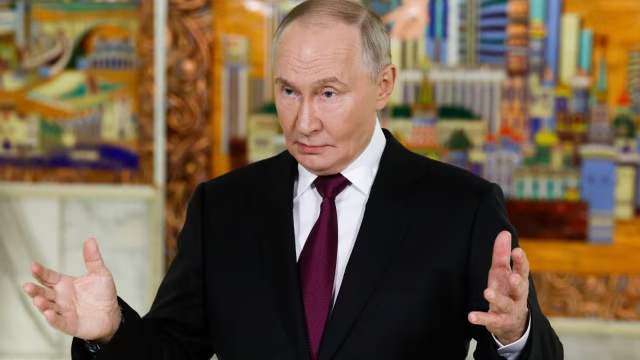
“You can love him or hate him, but you cannot ignore him” – The phrase was once used to describe Augustine, the 5thcentury Christian reformist theologian and bishop of Hippo Regius in North Africa, for his articulation on the concept of “grace”. It came to be attributed to many leaders in later centuries. One such leader is Vladimir Putin, the President of Russia. On his tenth visit to India on the invitation of Prime Minister Narendra Modi, who extended a red-carpet reception to the visiting leader, Putin created not just ripples but waves in several Western capitals.
Putin is a pariah in the Western world for many years now. He is seen by them as an anti-thesis to many of their liberal beliefs. Attempts were made in last more than a decade to tame him. But all remained unsuccessful. Russia, which became a member of the G-8 in 1998 owing to its political and economic reforms under Boris Yeltsin, was thrown out in 2014 when Putin annexed Crimea. Instead of pleading with the Western powers for his re-entry, Putin announced permanent withdrawal of his country from the group. Five years later, in 2022, he resorted to militarily challenge the regime in Ukraine over its treatment of Russian-speaking populations in Donbas region. Putin also objected to Ukraine’s moves towards joining NATO.
The Ukraine conflict escalated tensions between Russia and the NATO countries, leading to severe sanctions and further isolation of that country. Yet, three years later, Putin continues to be a thorn in the flesh for the NATO leaders. His proximity to countries like China and India is causing further irritation to them. The Op Ed by a group of European ambassadors in Delhi to “advice” India over how to treat Russia and their defiant defence in the face of Indian MEA’s disapproval, shows that the irritation is turning into frustration.
Just as a relentless military campaign could not repress Putin, a no-holds-barred diplomatic campaign did not deter Modi. The visit will be remembered more for the strong message it conveyed to the world than for the slew of agreements that will be signed over two days. Broad contours of that message will be – the world is changing; days of hegemonic order are over; a genuine multipolarity guided by strategic autonomy will be the way forward; and, most importantly, duplicity and double standards in international relations have no takers in the world.
India always stood for peaceful resolution of territorial disputes. It never used any excuse to side with any country in a conflict. In dealing with Russia too, the Indian leadership will not lose sight of its longstanding commitment to ending wars and working for peace. However, building peace is a two-way street and that calls for greater understanding to achieve it.
A Staunch Statist:
The West seemed to have failed to understand “Volodya” – as the Russian leader often referred to by his family and friends. Putin is a combination of charisma and enigma. The son of a soldier who fought in the World War II, Putin’s rise from a nondescript one-bedroom apartment in Leningrad (today’s Saint Petersburg) to the presidential palace in Moscow is a fascinating and intriguing story of grit, focus and hard-work.
After graduating in law from Leningrad State University, Putin opted to join the KGB and worked for sixteen years as an “agent” in Russia and East Germany. He was awarded a bronze medal “for outstanding services to the National People’s Army of the GDR”. He later rose to become the first civilian head of the FSB, post-Soviet avatar of the KGB. The fact that he volunteered to become a spy indicates a typical mindset. There is a Russian word “derzhavnik” – which means that “those who believe in the Russian greatness”. Agents in the KGB were trained in that mindset and eventually became staunch statists. Putin is no exception.
Putin was at Dresden in East Germany during the years of Glasnost that eventually led to the collapse of the Soviet Union. As the KGB agent, his job was to spy on the “main opponent”, the NATO. Putin’s antipathy for NATO has its origins there. He was not a Communist and probably never took party membership. But he was clearly disturbed by the collapse of Soviet Russia. “I regretted that the Soviet Union had lost its position in Europe, although intellectually I understood that a position built on walls and dividers cannot last. But I wanted something different to rise in its place. And nothing different was proposed. That’s what hurt”, he indignantly told in an interview. He later justified his view quoting Henry Kissinger, whom he met in Russia. “Frankly, to this day, I don’t understand why Gorbachev did that”, Kissinger is said to have quipped.
On the last day of 1999, Putin was with Yeltsin to celebrate the new year. Yeltsin, who was in poor health, suddenly turned to his prime minister and said, “Volodya! Take care of Russia”. The dawn of new millennium thus saw Putin rising to the highest position. Russia was facing its worst separatist terrorism in Chechnya and Dagestan at that time. Many thought that it was going to be Putin’s nemesis. But Putin thought otherwise. For him, protecting Russia’s integrity was more important than what would happen to him. “If we don’t put an immediate end to this, Russia will cease to exist. It was a question of preventing the collapse of the country. I realised I could only do this at the cost of my political career”, Putin told a friend. He described the danger as “Yugoslavization of Russia”. Putin carries that attitude to this day.
So, who is Putin? Yevgenia Albats, a Russian journalist, beautifully answered this question. “Putin is an extreme statist. For him, state always goes first”, she wrote, adding, “everything else – democratic institutions, personal liberties, individuality – everything else after this”. Like him or not, Russia comes first for him.