

(The article was originally published in Indian Express as a part of Dr Ram Madhav’s column titled Ram Rajya on September 05, 2026. Views expressed are personal.)
Four years ago, during his 76th Independence Day address on August 15, 2022, prime minister Narendra Modi invoked the idea of Vikasit Bharat (Developed India) for the first time. He gave a call for Pancha Prana – Five Fledges for the citizens of India, the first among which was the building of a developed India by the time the nation completes 100 years of its independence in 2047. He called the 25-year road map as ‘Amrit Kaal’. For the Amrit Kaal to succeed, citizens were called upon to take the other four pledges too – freedom from colonial mindset, pride in own heritage, strengthening national integrity, and upholding civic responsibility.
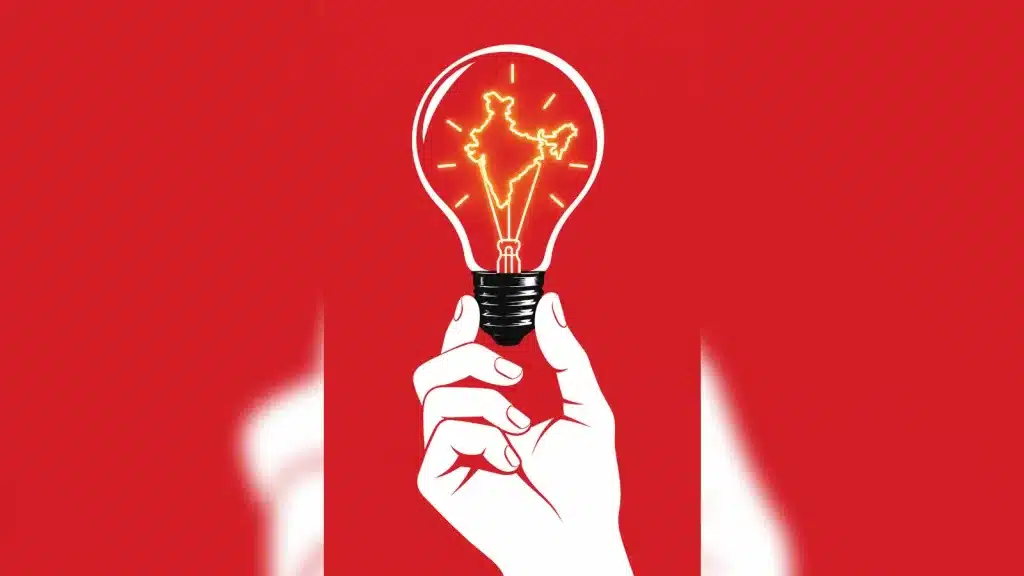
Prime Minister’s vision was tall and daunting. Niti Ayog projected Vikasit Bharat economic targets as achieving $15,000-18,000 per capita, 5 to 6 times the present levels and taking country’s GDP to $30 trillion, more than 7 times the present level. For these targets to be achieved, the economy has to register year-on-year GDP growth rate of at least 7 percent for a long time. Very few countries like China and Singapore could maintain such high growth rates for longer durations. But the prime minister is not a leader with empty dreams. Despite Covid and the global economic slowdown induced by it, despite Trump’s tantrums that caused serious economic and trade upheavals for many countries including India, and despite raging fears of an impending major global recession, Modi persisted with his agenda.
The result was a steady above 7 percent GDP growth of our economy in the last three years. While the rest of the world struggled, we recovered quickly from Covid induced sluggishness to register 7.3 percent growth in 2023-24, followed by 7.2 percent in 2024-25 and 7.8 percent in 2025-26. The controversy over the growth figures of 7.8 percent for the first quarter of 2026-27 is petty and pessimistic given this track record.
In his Independence Day address this year, prime minister continued his emphasis on Vikasit Bharat agenda by highlighting seven priorities, the Sapta Dhara – seven streams of development agenda. They are – manufacturing power, agriculture and food processing, technology and innovation, infrastructure and connectivity, self-reliance in defence production, green and blue economy and soft power. Prime minister underscored the need for reorienting our approach in order to achieve newer heights in these key sectors. “We have to change our work culture, and while changing it, we also have to change our thinking… We also have to accelerate the pace of reform”, he insisted.
Historical transformations are rarely linear. “There are decades when nothing happens; and there are weeks where decades happen”, Vladimir Lenin quipped during the Bolshevik Revolution. Modi too echoed a similar sentiment saying, “the pace of work that was not achieved in five to seven decades, we have to achieve in coming 5-7 years”. Countries like China that registered phenomenal progress witnessed such periods of accelerated change which resulted in their take off into the league of developed nations. During the two decades of 1978-97, under Den Xiaoping’s vision and pragmatism that unshackled the country from the Mao era romantic ideological bondages, China raced ahead on the path to unstoppable development. In 1980, India and China were comparable in GDP size – China at $303 billion and India at $186 billion. In per capita, India was ahead with $582 against China’s $307. Two decades later, in 2000, China surged ahead to $1.21 trillion GDP while India could only reach $468 billion. In per capita terms too, China surged ahead to $959 against India’s $452. During those two decades, China singularly focused on developing its manufacturing sector and emerged as the “factory of the world”.
In the last couple of decades, with its advances in services sector, India emerged as the “office of the world”. But PM Modi is determined to achieve not incremental but spectacular growth in the next two decades. His vision and ambition reflected in the call to the countrymen that “we need to work towards surpassing the scale of the goals and ambitions we are pursuing”. Why shouldn’t 50 Indian companies be there in the Fortune 500 list? Why shouldn’t Indian banks be among the top banks in the world? Can’t one or two Indian pharma companies be among the top five global companies? Shouldn’t our consulting firms or accounting firms be among the top firms in the world?
The only answer to these questions raised by the prime minister is for the entire country – bureaucracy, state and local governments, industry and entrepreneurs, and leaders in all other sectors like agriculture, education, technology and innovation – to catch up with the pace of the prime minister. Vikasit Bharat should be the ‘whole of the nation’ ambition.