


(The article was originally published in Indian Express as a part of Dr Ram Madhav’s column titled Ram Rajya on November 07, 2026. Views expressed are personal.)
Last week, a video of the speech of the ITBP chief’s address leaked out causing consternation in some circles. Shatrujeet Kapur, the outgoing chief of the paramilitary force, was heard in that now withdrawn video calling China the “biggest adversary” and disclosing that a face-off with the Chinese forces “happened at several locations in Arunachal, and it still continues” in the last few weeks. The opposition found in the comments of the ITBP chief enough material to pounce on the government. The Congress spokespersons accused the government of suppressing facts about the border situation and keeping the country in dark. Mallikarjun Kharge, the octogenarian president of the party, too jumped in questioning “clean chits to China” and taking potshots at prime minister Narendra Modi.
Everybody knows that the India-China border dispute is sixty-five years old. There have always been transgressions by the Chinese Army along the the 4057-km long Line of Actual Control (LAC) during that entire period. Even during the UPA regime, official reports disclosed that well over 600 “transgressions” – the government’s euphemism for intrusions by the Chinese Army – occurred along LAC during 2010-2013. Defence Minister, A K Antony, did not deny the reports. He instead chose to reassure the nation that its interests would be protected.
Such intrusions continued in later years too. But the Modi government introduced an important shift in the border patrolling policy after 2014 stand-off. Starting with Doklam tri-junction face-off in 2017, India not only engaged in diplomatic manoeuvres but resorted to a strong ground posturing also. The earlier practise of disengagement and withdrawal in the event of patrolling face offs between the two sides was given away and active engagement and on ground stand off were encouraged. ‘Proactive diplomacy together with strong ground posturing’ is the new mantra for border patrolling along the LAC. That firm on ground posturing, witnessed from Doklam to Galwan, sent a clear message to the counterpart that India would brook no lenience on the ground too.
But what the opposition missed in ITBP chief’s comments was his warning about the growing levels of technology disparity between India and China. He warned that China cannot be confronted using traditional methods since the arrival of drones had changed the nature of warfare and India “must embrace drone and anti-drone systems in a big way”. All future confrontations, either border skirmishes like the ones with China or limited conflicts like the Operation Sindoor with Pakistan, will be heavily dependent on advanced technologies. It is on this subject that real debate should focus. Kapur was explicitly saying that we need to adapt to these newer technologies.
India is investing heavily in equipping our forces with these modern weapons like the drones and the anti-drone systems. One important lesson that we can learn from our adversary, China, is that in strategising about our technology preparedness, it is capability that matters more than parity. Two wars that we witnessed recently – the US-Iran War and the Ukraine-Russia War – tell us the story of how a relatively weaker country could successfully ward off a grave military threat from an adversary several times stronger in military strength. It is not the weapon parity that mattered, but the capability to counter the adversary using technology advantage.
In 1990s and 2000s, when China was a rising military power, it did not try to match the numbers of its military hardware with that of America. Instead, it focused on developing the capability to counter that US hardware of ships and satellites. When the US deployed hundreds of spy satellites over the Chinese Low Earth (LEO) and High Earth Orbits (HEO), China did not look to match it in number of satellites. Instead, it developed ground-based laser systems that could “dazzle” or even “kill” those satellites. Similarly, to tackle the powerful US Navy, China did not rush to increase the number of its naval vessels. Instead, it developed sea-skimming supersonic missiles that can travel distances up to 500 kms unnoticed by the enemy naval radar systems and destroy enemy ships and submarines. This capability of China had led to the US Army designating several of its platforms, systems, and bases as “wasted assets.”
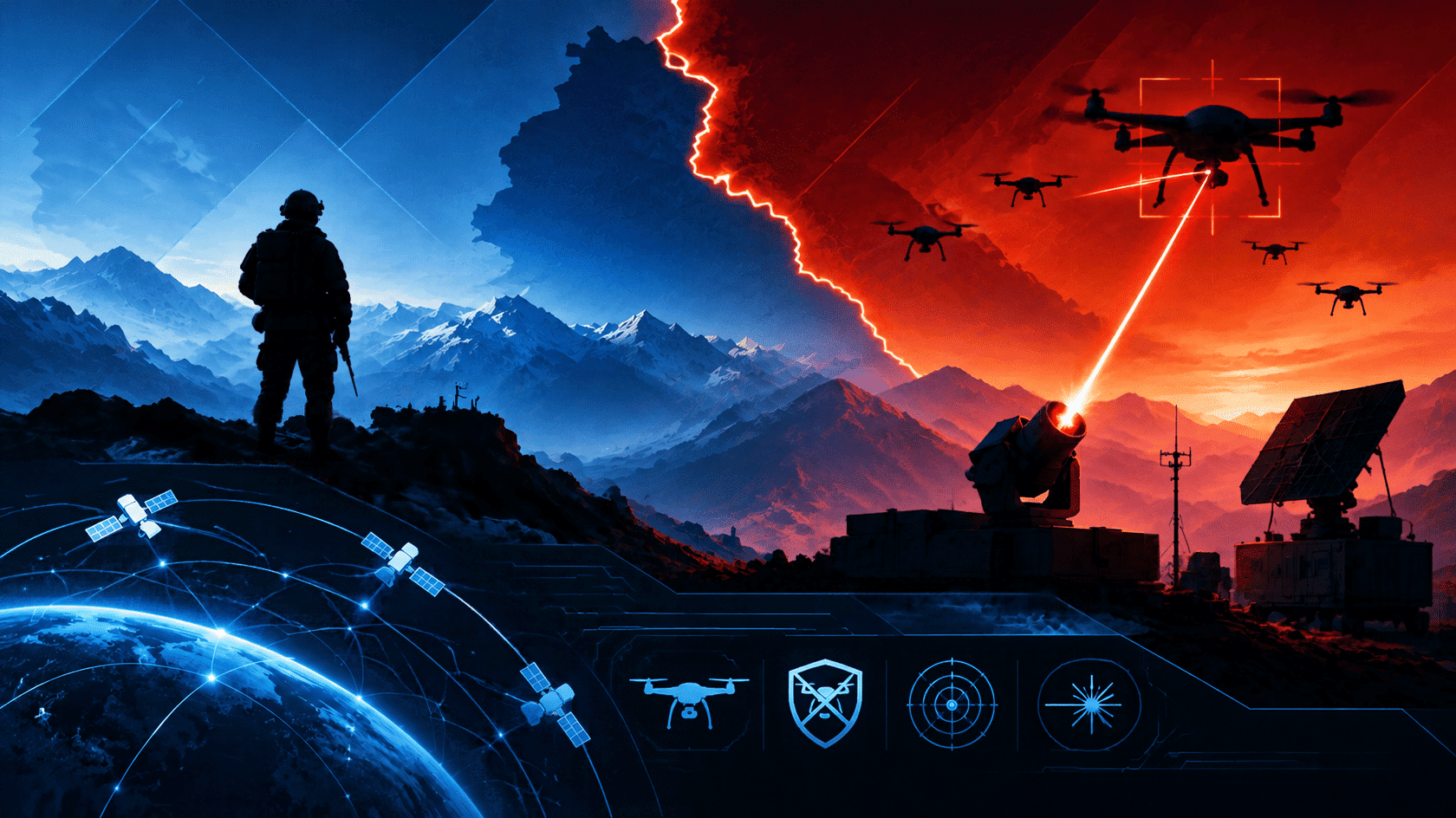
The ITBP chief was suggesting that India should develop such drone and anti-drone capability. In recent years, India is heavily investing in such systems. The DRDO has recently developed high-power laser-based directed-energy weapons (DEWs) that can track and destroy individual drones as well as drone swarms, a new threat mastered by India’s adversaries.
“A nation’s ability to fight a modern war is as good as its technological ability”, Frank Whittle, the British RAF officer who invented the turbojet engine, once quipped. An apt quip for today.