

(The article was originally published in Indian Express as a part of Dr Ram Madhav’s column titled Ram Rajya on August 01, 2026. Views expressed are personal.)
Is India emerging as the third power in the Indo-Pacific Region (IOR) alongside the US and China? Several observers started asking after Prime minister Narendra Modi’s proactive diplomacy in the region in recent years.
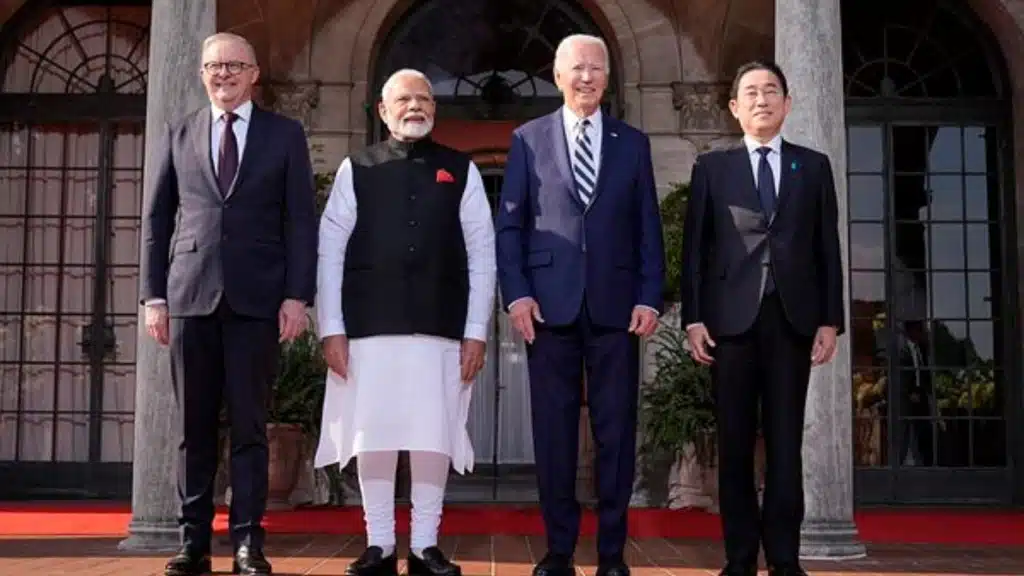
India’s interests in this most happening region are not new. But in the last decade Modi substantially increased his engagements with the countries in the region. He participated in the ASEAN-India Summits 12 times, East Asia Summits 9 times, visited Japan 8 times, Singapore 5 times, Indonesia 4 times and Australia 3 times. He was present in all 6 QUAD leader-level summits since 2021. Modi is the only Indian prime minister to have visited almost every country in the Indo-Pacific except Cambodia, Taiwan and North Korea. He met with the leaders of 14 South Pacific Island nations thrice in the last twelve years. In the Middle East, except the war-torn countries like Libya, Syria, Lebanon and Iraq, Modi visited almost all other countries. Interestingly, despite differences, Modi and Chinese president Xi Jinping bumped into each other over 20 times in the last 12 years, although not all of them can be called serious engagements.
In his famous “confluence of two seas” address to the Indian Parliament in 2007, the visiting prime minister of Japan, Shinzo Abe invoked the terminology of “Indo-Pacific” for the first time for the region otherwise known as “Asia-Pacific” since 1980s. Soon the term captured the attention of the world with the US beginning to use the phrase “Indo-Asia-Pacific” initially before officially adopting the term in 2018. It even renamed its command as Indo-Pacific Command. Several countries followed suit. Countries that have a proclaimed Indo-Pacific Strategy today include the US, Japan, France, Germany, the Netherlands, the United Kingdom, South Korea, Canada and Bangladesh. The European Union and the ASEAN also published their documents while India and Australia embedded their strategy in various vision papers.
Two countries that refused to adopt this terminology underscoring the tensions in the region were China and Russia. In 2018, Wang Yi, the Chinese foreign minister, mocked at the Indo-Pacific as an “attention-grabbing idea” that would “dissipate like sea foam” dubbing it as an effort by the Western powers to encircle and contain China.
Keeping the complexities in mind, Modi adopted a gradualist approach to dealing with the IOR. In the QUAD, while the US proposed “Free and Open Indo-Pacific” – FOIP as the motto, Modi suggested Free, Open and “Inclusive” Indo-Pacific – FOIIP – thus leaving some ambiguity over the question of exclusion of any country. With a view to mitigating any suspicion about India’s role, he proclaimed the concept of “ASEAN Centrality” to the Indo-Pacific at the Shangri La Dialogue at Singapore in 2017. However, in the last couple of years, a new assertion is visible. First came the initiative to develop a $10 Billion major maritime facility called the Great Nicobar Island Development Project. This project, sitting just 40 nautical miles North of the busy Malacca Straits which witnesses around 100,000 ship crossings annually, 60 percent belonging to China, is in a way India’s proclamation of its geo-strategic activism in the region.
Modi’s engagements with the leaders of Japan, Indonesia, New Zealand and Australia in July indicated further power assertion of the country. These engagements went far beyond trade and technology, involving defence deals and strategic maritime collaborations. During the visit of Japanese prime minister Sanae Takaichi to Delhi in July first week, India formally agreed to build a trilateral track 1.5 dialogue mechanism with Japan and Philippines hinting at its readiness to step into one of the tense maritime zones – the East and South China Sea.
The Takaichi government has increased its defence budget last year to a record $58 billion inching towards the 2027 target of 2 percent GDP spending on defence. South Korea, another major power in the region, also increased its defence spending steeply to almost $45 billion and aims to take it to 3.5 percent of its GDP by 2035. This spending surge is indicative of the realisation among the countries in the region that its tall talk about ‘Pivot to Asia’ and ‘Asian Rebalancing’ notwithstanding, the US’ interest and involvement in the region is on a downward slide and the China challenge is mounting further. The ASEAN countries, for long, longed to remain out of the big power competition. In an interview in 2013, Lee Kuan Yew, the legendary Singaporean leader, argued that “the size of China’s displacement of world balance is such that the world must find a new balance in 30 to 40 years”.
Through his recent initiatives, Modi raised the bar high for India in the Indo-Pacific. Through his personal relationships with leaders in the region and the deftness in managing relations with diverse powers based on the principle of strategic autonomy, is Modi poised to build that balance?