Sonia Gandhi's criticism of Government over Iran is misplaced
September 27, 2025



|
Getting your Trinity Audio player ready...
|
(The article was originally published in Indian Express on September 27, 2025 as a part of Dr Madhav’s column titled ‘Ram Rajya’. Views expressed are personal.)
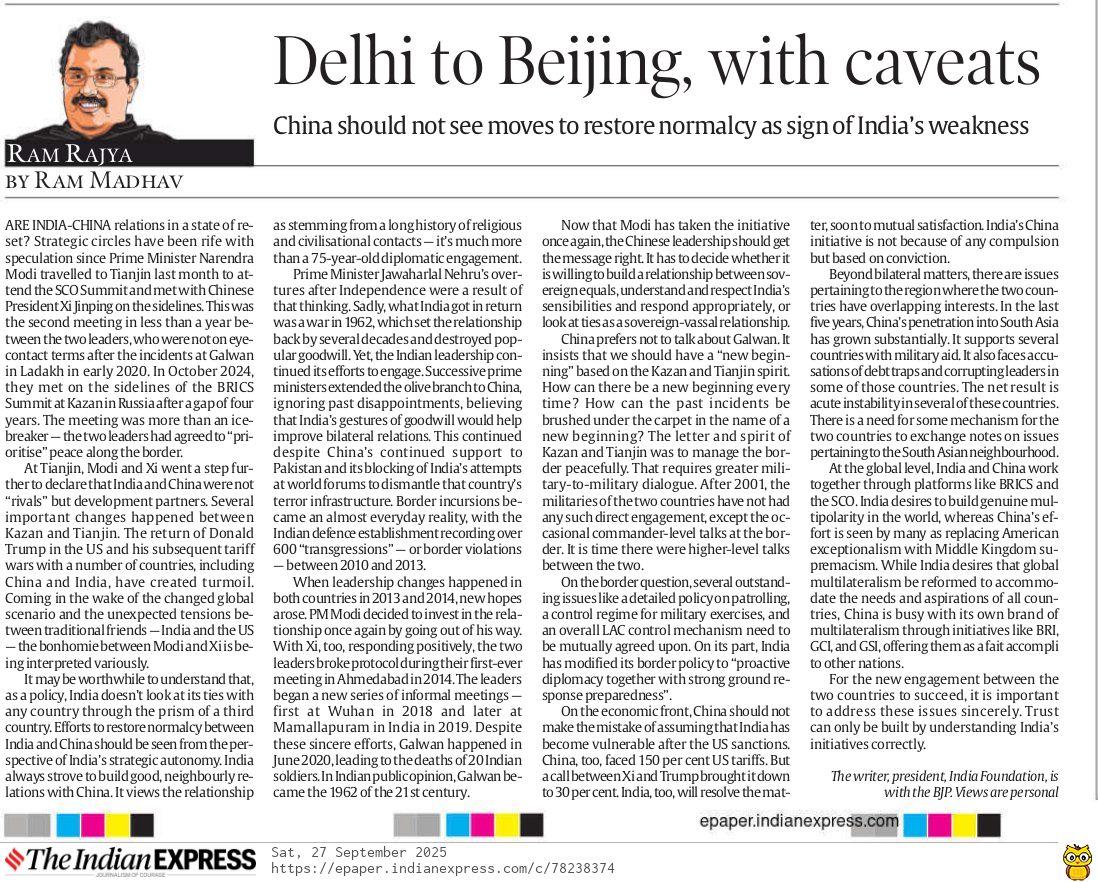
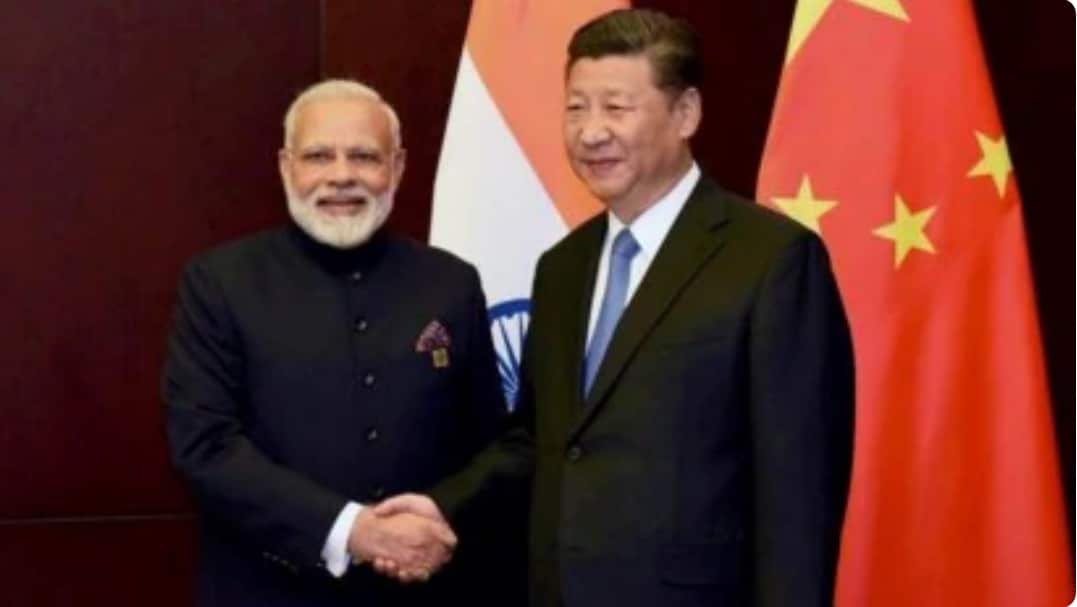
Are India-China relations on a reset mode? Strategic circles are agog with speculation ever since Prime Minister Narendra Modi travelled to Tianjin last month to attend the SCO Summit and met Chinese President Xi Jinping on the sidelines. This was the second meeting in less than one year for the two leaders, who were not even on eye contact after the incidents at Galwan in Ladakh in early 2020. In October 2024, the two leaders met on the sidelines of the BRICS Summit at Kazan in Russia after a gap of four years. It served as more than an ice breaker in which the two leaders had agreed to “prioritize” peace and tranquillity along the border.
Ten months later, at Tianjin, the two leaders went one step further to declare that India and China are not “rivals” but development partners. Several important changes happened between Kazan and Tianjin. Return of Donald Trump in USA and his subsequent tariff wars with a number of countries including China and India led to a major turmoil. Coming in the wake of the changed global scenario and the unexpected tensions that arose between traditional friends, India and US, this bonhomie between Modi and Xi is being interpreted variously.
It may be worthwhile to understand that India, as a policy, doesn’t look at its relations with any country from the prism of a third country. Efforts to restore normalcy between India and China should be seen from India’s strategic autonomy prism only. India always strove to build good neighbourly relations with China. It viewed the relationship as more than merely a 75-year-old diplomatic relationship between the two countries but a long standing historical, religious and civilisational relationship too.
Prime Minister Jawaharlal Nehru’s proactive overtures after independence were a result of that thinking. Sadly, what India got in return was a war in 1962, which set the relationship back by several decades and destroyed popular goodwill permanently.
Yet, the Indian leadership continued its efforts to engage. Successive prime ministers extended olive branch to China ignoring past disappointments in the belief that India’s gesture of goodwill would help improve bilateral relations. This continued despite China’s continued support to Pakistan and blocking of India’s attempts at the world forums to dismantle that country’s terror infrastructure. Border incursions became almost an everyday reality with Indian defence establishment recording over 600 “transgressions” – a euphemism for border violations – between 2010 and 2013.
When leadership change happened in both countries in 2013-14, new hopes arose. Prime minister Modi decided to invest in the relationship once again by going out of the way. With president Xi too responding positively, the two leaders broke protocols and sat on a swing in Ahmedabad in 2014 during their first ever meeting. Both the leaders began a new series of informal meetings – first at Wuhan in 2018 and later at Mamallapuram in India in 2019.
Despite these sincere efforts, Galwan happened in June 2020 leading to the deaths of 20 Indian soldiers. The relationship has come to a brink once again. In terms of Indian public opinion, Galwan became 1962 of the 21st Century.
Four years later, when Modi once again took the initiative, Chinese leadership should get the message right. It must understand that India did the utmost that it could do. Onus of taking it forward now lies squarely on China. It has to decide whether it is willing to build a relationship of sovereign equals, understand and respect India’s sensibilities and responds appropriately or looks at it as a sovereign-vassal relationship.
China prefers not to talk about Galwan. It insists that we should have a “new beginning” based on Kazan and Tianjin spirit. How can there be a new beginning every time? How can the past incidents be brushed under the carpet in the name of a new beginning?
The letter and spirit of Kazan and Tianjin was to manage the border peacefully. That requires greater military-to-military dialogue. After 2001, militaries of the two countries did not have any direct engagement except the occasional commander level talks at border. It is time two militaries began engaging at higher level. On the border question too, several outstanding issues like detailed policy about patrolling, military exercises control regime, and overall LAC control mechanism need to be mutually agreed to. On its part, India modified its border policy to “proactive diplomacy together with strong ground response preparedness”.
On the economic front, China should not make the mistake of assuming that India has become vulnerable in the light of the US sanctions. China too faced 150 percent US sanctions. But a call between Xi and Trump brought it down to 30 percent. India too would resolve the matter soon to mutual satisfaction. India’s China initiative is not because of any compulsion but due to its conviction.
Beyond bilateral issues, there are issues pertaining to the region where the two countries have overlapping interests. In the last five years, China’s penetration into South Asia has grown substantially. It supports several countries with military aid constituting almost 70 percent in some cases. It also faces accusations of debt traps and corrupting leaders in some of those countries. Net result is acute instability in several of these countries. There is a need for some mechanism for the two countries to exchange notes on the issues pertaining to the South Asian neighbourhood.
At the global level, India and China work together through platforms like BRICS and SCO. India desires to build genuine multipolarity in the world whereas China’s effort is seen by many as replacing American exceptionalism with Middle Kingdom supremacism. While India desires that global multilateralism be reformed to accommodate the needs and aspirations of all countries, China is busy with its own brand of multilateralism through initiatives like BRI, GCI, and GSI and offering them as fait accompli to other nations.
For the new engagement between the two countries to succeed it is important to address these issues sincerely. Trust can only be built by understanding India’s initiatives correctly.