

(The article was originally published in Indian Express on January 03, 2026 as a part of Dr Madhav’s column titled ‘Ram Rajya’. Views expressed are personal.)
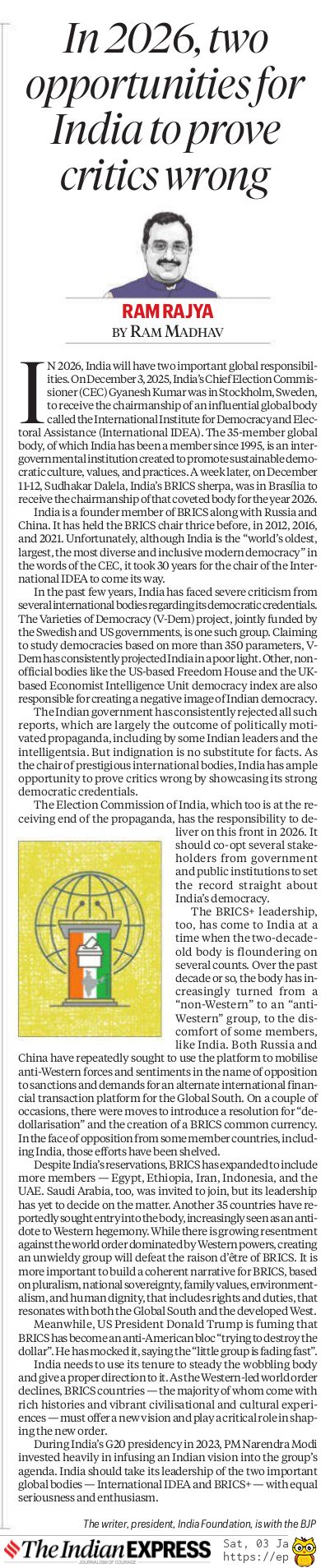
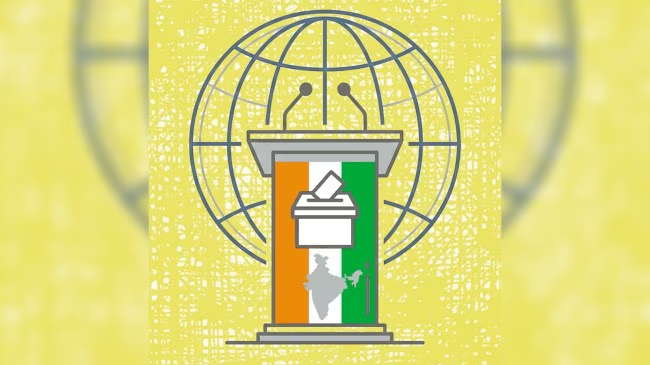
Year 2026 brings two important global responsibilities to India. On 3 December 2025, India’s chief election commissioner (CEC) Gyanesh Kumar was in Stockholm, Sweden, to receive the chairmanship of an influential global body called International Institute for Democracy and Electoral Assistance – International IDEA. The 35-member global body, of which India has been a member since 1995, is the only intergovernmental institution created to promote sustainable democratic culture, values and practises in the world. A week later, on 11-12 December, Sudhakar Dalela, India’s BRICS sherpa, was in Brasilia, capital of Brazil, chair of BRICS+ for the year 2025, to receive the chairmanship of that coveted body for the year 2026.
Both the international and intergovernmental bodies are of utmost importance to India. India is a founder member of the BRICS group along with Russia and China. It held the chair of BRICS thrice before – in 2012, 2016 and 2021, and will be chairing it for the fourth time in 2026. Unfortunately, although India is the “world’s oldest, largest, the most diverse and inclusive modern democracy” in the words of the CEC, it took 30 years for the chair of the International IDEA to come its way, that too after some proactive steps taken by the CEC and his team. Tenure of the chair for both organisations will be a brief one year only.
India faced severe criticism from several international bodies regarding its democratic credentials in the last few years. Varieties of Democracy (V-Dem) project, jointly funded by the Swedish and US governments, is one such group, which operates out of the Lund University in Sweden. Claiming to study democracies based on over 350 parameters, V-Dem consistently projected India in a poor light, often caricaturing it as “electoral autocracy”. Some other non-official bodies like the US-based Freedom House that downgraded India to “partly free” in 2021 and maintained that status since, and the UK-based Economist intelligence unit democracy index that called India a “flawed democracy” are also responsible for creating a negative image for Indian democracy in the world. Even International IDEA’s Global State of Democracy report described India as a mid-range performer only.
Indian government consistently rejected all such reports, largely the outcome of a biased and politically motivated propaganda, not unsurprisingly by some of its own leaders and intelligentsia. But indignation, is no substitute for information and facts. As the chair of the prestigious international body, India gets ample opportunity to prove the critics wrong by showcasing its strong democratic credentials through various forums and programs.
While accepting the chairmanship, Gyanesh Kumar said that India “envisions to share… the democratic values and principles deeply enshrined in India’s civilisational heritage”. He also stressed that “India’s chairmanship will be decisive, ambitious and action oriented, demonstrating to the world at large that democracies can lead to a united, peaceful, resilient and sustainable world”. India declared the same as the theme for its chairmanship.
The election commission of India, which itself is at the receiving end of the propaganda, has a great responsibility to deliver on this front in 2026. It should coopt several stakeholders from government and public institutions to address the gigantic task of setting the record about India’s democracy straight.
On the other hand, the all-important BRICS+ leadership too has come to India at a time when the two-decade-old body is floundering on several counts. BRICS is an important non-Western grouping that has the potential to play a significant role in shaping the future order of the world. However, over the last decade or so, the body has increasingly turned from a ‘non-Western’ to an ‘anti-Western’ group causing discomfort to some members like India. Both Russia and China, two founder members and key global players, repeatedly sought to use the platform to mobilise anti-Western forces and sentiments in the name of opposition to sanctions and demands for an alternate international financial transactions platform for Global South. On a couple of occasions, there were moves to introduce a resolution for “de-dollarisation” and creation of a BRICS common currency. In the face of opposition from some member countries, including India, those efforts have been shelved.
Despite India’s reservations, BRICS has expanded to include more members – Egypt, Ethiopia, Iran, Indonesia, and UAE. Saudi Arabia too was invited to join, but the leadership of the country is yet to decide on the matter. As per the reports, besides the current eleven member states, another 35 countries have sought entry into the body increasingly seen as an antidote to the Western hegemony. While there is growing resentment against the hegemonic world order dominated by the Western powers, creating an unwieldy group will defeat the very raison d’etre of BRICS. What is more important is to build a coherent narrative for BRICS, based on values like pluralism, national sovereignty, family values, environmentalism and human dignity that includes rights and duties, that resonates well with both the Global South as well as the developed West.
Meanwhile, Donald Trump is fuming that the BRICS has become an anti-American bloc “trying to destroy dollar”. He also mocked at it saying the “little group is fading fast”.
India needs to use the opportunity as the chair of the group to steady the wobbling body and give a proper direction to it. As a non-Western group, BRICS is yet to find a coherent articulation of its vision for the world in general and Global South in particular. As the Western-led world order declines in power and influence, BRICS countries – majority of whom come with rich histories and vibrant civilisational and cultural experiences – must come forward to offer a new vision for the mankind and play a critical role in shaping the new order.
During India’s presidency in 2023, prime minister Modi invested heavily in infusing a quintessentially Indian vision into the G-20 group agenda. India should take its leadership of the two important global bodies – International IDEA and BRICS+ – also with equal seriousness and enthusiasm and set a new narrative rolling for the mankind’s future.