

(The article was originally published in Indian Express on December 27, 2025 as a part of Dr Madhav’s column titled ‘Ram Rajya’. Views expressed are personal.)
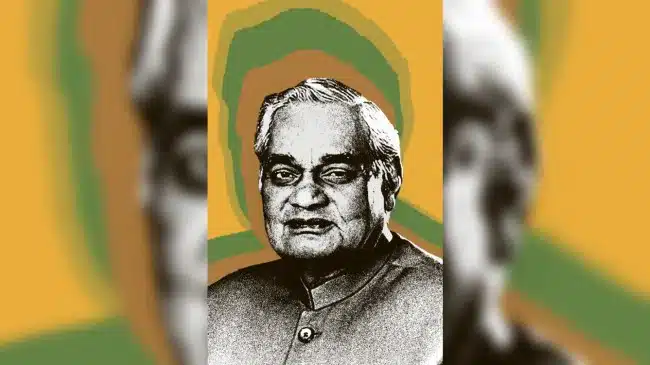
This Christmas marked the end of the centenary year of one of the greatest sons of India, described by many as an “Ajatshatru” – one without enemies, a gifted orator and poet with a mesmerising control over language, a leader for whom the nation came first above everything else, including his own party, and, above all, a sterling human being – Atal Bihari Vajpayee. Not all leaders are remembered after hundred years. But some, like Vajpayee, are unforgettable because, “Vajpayee’s era spanned across generations” as Arun Jaitley once observed, while his aura spans across decades and probably centuries. Like Tilak, Gandhi and Patel in the pre-independence era, Vajpayee too will be remembered for his distinctive contributions to the nation post-independence. That’s why prime minister Narendra Modi, in his emotional ode to the departed leader in August 2018, described Vajpayee as “a leader for the ages”.
Vajpayee had many firsts to his credit. He was ideologically and politically the first genuinely non-Congress prime minister of the country. He was also the first leader to show that coalitions can work. India entered coalition era in 1989. But most of those coalitions were unstable arrangements born out of political compulsions. Vajpayee used to say that coalitions should not be seen only as a political compulsion, but they should be taken as “the aspiration of the people”. He was the first successful prime minister to run a 23-party coalition government for a full five-year term. His humility, patience to listen, and connect with different sections of the political establishment irrespective of ideological differences made successful functioning of that coalition possible. The phrase “Coalition Dharma” was a product of his politics.
As Modi rightly said in his obituary blog, Vajpayee was “ahead of his times”. He created precedents, set examples, and sought to change the character of Indian politics. “Character of power is same always”, he once wryly commented, adding that “we should try to transform that character through personal example”. He tried to set that personal example, initially as the leader of the opposition for several years and later as the leader of the House too. The scintillating speech he delivered while demitting office, after the 13-day government formed by him in 1996 failed to muster numbers, stands out as one of his best oratories. “Sarkaren aayegi aur jaayegi; partiyan banegi aur bigadegi; magar ye desh rehna chahiye, desh ka loktantra amar rehna chahiye” (Governments will be formed and dissolved; parties come and go; but this nation should remain, and this democracy should remain eternally) – he said in an emotionally choked voice. That was his message to the parties to change their character. Did he succeed? No. He lost power once again in 1999 when one of the coalition partners withdrew support and he failed to secure the vote of confidence of the parliament by just one vote – that too a controversial one. What if the character of power doesn’t change? “Just make sure you don’t lose your laughter”, he said in a lighter note. Incidentally, he had the last laugh when the elections that followed brought a much stronger coalition led by him back to power which remained until 2004.
Although Vajpayee couldn’t change the character of power politics completely, he did influence the character of his own party predominantly. The BJP functioned as the most constructive opposition party to the scam-ridden government of UPA during the decade of 2004-14, initially under the leadership of L K Advani and later under Sushma Swaraj. The final address of Swaraj in the parliament was a glowing testimony to the kind of democratic spirit that Vajpayee had infused in the BJP leadership. Talking about the 15th Lok Sabha that was concluding its term in early 2014, Swaraj said “I say this with a lot of affection that my brother Kamalnath would complicate matters through his mischief while respected Shinde ji would resolve them through his decency. And the mediation by Sonia ji sitting in between this mischief and decency, gentleness and patience of honourable prime minister, and Advani ji’s commitment to propriety were responsible for the successful functioning of the house”. In true Vajpayee spirit, Sushma concluded her address by emphasising that “there is one strong message at the root of Indian democracy – we are adversaries to each other, but not enemies”.
The elections in 2014 brought Narendra Modi-led government to power. Modi, who described Vajpayee as “father”, continued with the Vajpayee spirit by running a coalition government of more than 25 parties despite securing absolute majority in the house both in 2014 and again in 2019. He extended an olive branch to the Congress Party by granting the status of the principal opposition although it failed to secure minimum number of seats (10 percent of the house strength) required to qualify for that. He consistently tried to engage with the opposition in matters of national interest.
Some opposition leaders used to deride Vajpayee that he was a “right man in a wrong party”. Vajpayee would vehemently challenge them by asking how can the tree be bad if the fruit is good? And if the tree is bad, how can it produce a good fruit? “What good is this right man for you anyway?”, he once jocularly asked them. He was right. Last 10-12 years showed that there is no place for the Vajpayee spirit in the opposition’s scheme of politics.
In 1926, after getting elected to the German Reichstag as one of the 12 delegates of Hitler’s party, Joseph Goebbles, who would become Hitler’s minister for propaganda seven years later, was surprised to find that he and his other eleven colleagues, seated in a single row on the periphery of the plenary hall, had the capacity to destruct, obstruct and paralyse democratic structures and processes at will. “The big joke of democracy is that it gives its mortal enemies the means to its own destruction”, he quipped then.
Would the opposition in India remain Goebbelsian or can they ever find that “right man” in their party?