

(The article was originally published in Indian Express as a part of Dr Ram Madhav’s column titled Ram Rajya on August 15, 2026. Views expressed are personal.)
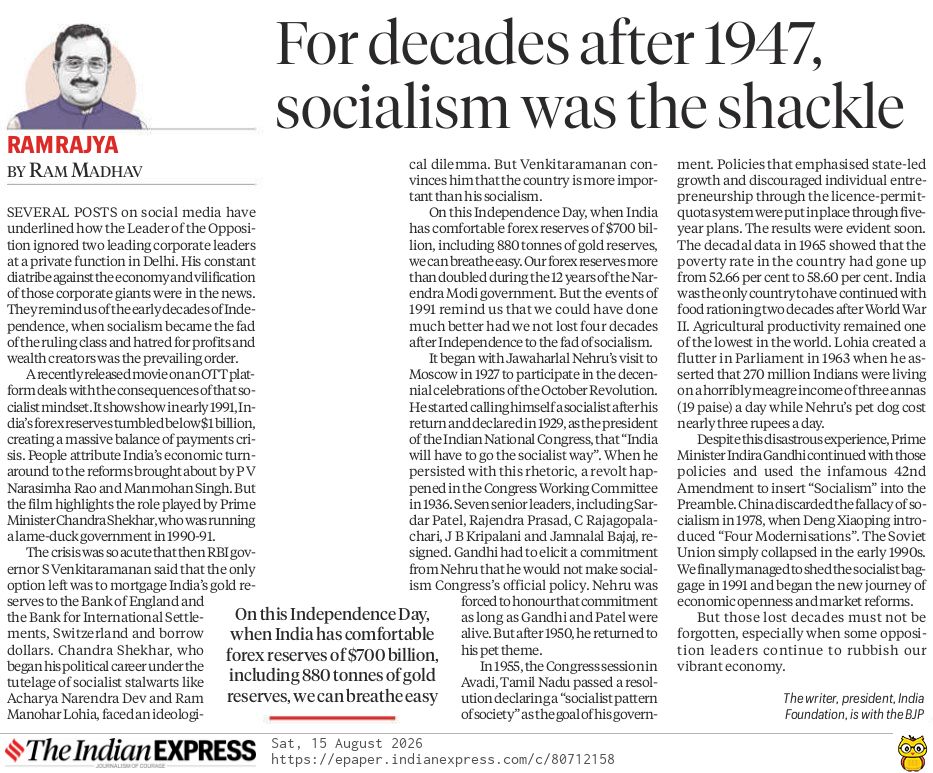
A viral social media narrative highlighting how the Leader of Opposition completely ignored two leading corporate leaders of the country at a private function in Delhi caught my attention. His constant diatribe against Indian economy and vilification of those corporate giants too were very much in news. They remind us of the early decades of independence when socialism became the fad of the ruling class and hatred for profits and wealth creators the order.
A recently released movie on OTT platforms dealt with the consequences of that socialist mindset when the country was almost pushed into bankruptcy. Made exemplarily well, it talks about the months in early 1991 when India’s forex reserves tumbled below $1 billion creating a massive balance of payments crisis. People attribute India’s economic turn-around to the reforms brought about by P V Narasimha Rao and Manmohan Singh after 1991. But the movie highlights the role played by prime minister Chandra Shekhar, who was running a lame duck government in 1990-91.
Crisis reached a stage when the then governor of the Reserve Bank of India (RBI), S Venkitaramanan proposed that the only option left was to mortgage country’s gold reserves to Bank of England and Bank for International Settlements, Switzerland and borrow dollars. Chandra Shekhar, who began his political career under the tutelage of the socialist stalwarts like Acharya Narendra Dev and Ram Manohar Lohia, faced a big ideological dilemma. But Ramanan convinces him that country is more important than his socialism and Shekhar takes that difficult decision to ward off the looming balance of payments crisis. Had that not happened, India would have witnessed street riots and a civil war like situation.
On this 80th Independence Day, when the country is comfortably sitting on almost $700 billion forex reserves with the RBI, which includes a massive 880 tonnes of gold reserves, we can breathe easy that those bad days of bankruptcy would never return. Our forex reserves have more than doubled in the last twelve years of Narendra Modi Government and we today have enough for almost one full year of import cover whereas the international standard for import cover is only 2-3 months. Indian economy is the fastest growing economy today. With a GDP of above $4 trillion, it stands shoulder to shoulder with Japan and Germany occupying 4th or 5th position in the world. In Purchasing Power Parity (PPP) terms, we are a $19 trillion economy, occupying 3rd position in the world. But the important question that we should ask is whether we could have done better. The answer lies in the happenings in the first four decades of our independence, ‘the lost decades’ in terms of our economic development.
Story begins with Jawaharlal Nehru’s three-day visit to Moscow in 1927, accompanying his father, Motilal Nehru, to participate in the decennial celebrations of the establishment of the Soviet Republic. He started calling himself a socialist after the return and declared in 1929, as the president of the Indian National Congress, that “India will have to go the socialist way, if she seeks to end her poverty and inequality”. He also declared that “our problems in India are same as those that faced Russia some years ago and they can be solved in the same manner in which Russians solved them”. Nehru could gather a motley group of followers behind him for his agenda, but the larger party leadership was unimpressed. When Nehru persisted with his socialist rhetoric, a revolt happened in Congress Working Committee in 1936, and seven senior leaders including Sardar Patel, Rajendra Prasad, Rajagopalachari, Kriplani and Jamnalal Bajaj resigned. Gandhi had to intervene and elicit a commitment from Nehru that he would not make socialism the official policy of the Congress.
Nehru was forced to honour that commitment until Gandhi and Patel were alive. But after 1950, when both were removed from the scene, he returned to his pet theme. P S Mahalanobis, a physicist who developed passion for statistics without any formal degree in economics or statistics, became his Man Friday for implementing socialist economic model in the country. What was thwarted in 1936 became the official Congress policy two decades later in 1955 when Nehru got the Congress session at Avadi in Tamil Nadu to pass a resolution declaring “socialist pattern of society” as the goal of his government. Policies that emphasised on state-led growth and seriously discouraged individual entrepreneurship through licence-permit-quota system were put in place through five-year plans. The results were evident soon. The decadal data in 1965 showed that poverty rate in the country went up from 52.66 percent to 58.60 percent with the exact number of poor people growing from 198.7 million in 1955 to 301.7 million in 1965.India was the only country in the world to have continued with food rationing 19 years after the 2nd World War. Agricultural productivity remained one of the lowest in the world. Lohia, created a flutter in the Indian Parliament in 1963 when he asserted that 270 million Indians were living on a horribly meagre income of three annas (19 paisa) a day while Nehru’s pet dog had spent nearly three rupees a day.
In spite of this disastrous experience, prime minister Indira Gandhi continued with those policies and used the infamous 42nd Amendment to the Indian Constitution to insert ‘Socialism’ into the Preamble, which still remains there.
China, another country that followed the same fallacy of socialism, discarded it in 1978, when supreme leader Deng Xiaoping introduced ‘Four Modernisations’. Having followed socialism for seven decades, the Soviet Union simply collapsed in early 1990s, when Gorbachev attempted to bring it out of that morass. We too finally managed to shed the socialist baggage in 1990 and began the new journey of economic openness and market reforms. In just less than four decades, we reached where we are today.
But those lost decades must not be forgotten especially when some opposition leaders betray the signs of their ancestors and continue to rubbish our vibrant economy.