

(The article was originally published in Indian Express on February 07, 2026 as a part of Dr Madhav’s column titled ‘Ram Rajya’. Views expressed are personal.)
Spokespersons of the Congress Party are not illiterates. They clearly understood what I wrote in my column last week. I not only held Nathuram Godse’s act of killing Gandhi wrong but also argued that the reasons that he gave for that criminal act were also erroneous. The Congress spokesperson’s rejoinder to my column smacked of a deliberate and futile attempt to twist my arguments. Their desperation seems to be due to the fact that my article exposed the less talked about reality that their darlings like Jawahar Lal Nehru were more responsible for India’s partition in 1947 than Gandhi as accused by Godse.
Since the spokesperson betrayed his inability to understand what I wrote in the last column, let me give more details about the events and actors of the tragic times. It is undisputable that Gandhi tried until the end to prevent partition. But Nehru’s singular obsession during those testing months had been to grab political power from the British by whatever means. No ideology mattered for him nor any larger purpose. Not even friends and colleagues.
Subhash Chandra Bose was the first to call Nehru’s bluff in a frank 40-page letter he wrote to the latter in March 1939. In that letter, Bose sharply criticised Nehru for his political conduct, policy ambiguities and perceived hypocrisy. In his reply, Nehru admitted to his failings but insisted that he did all that in order to avoid a split with Gandhi.
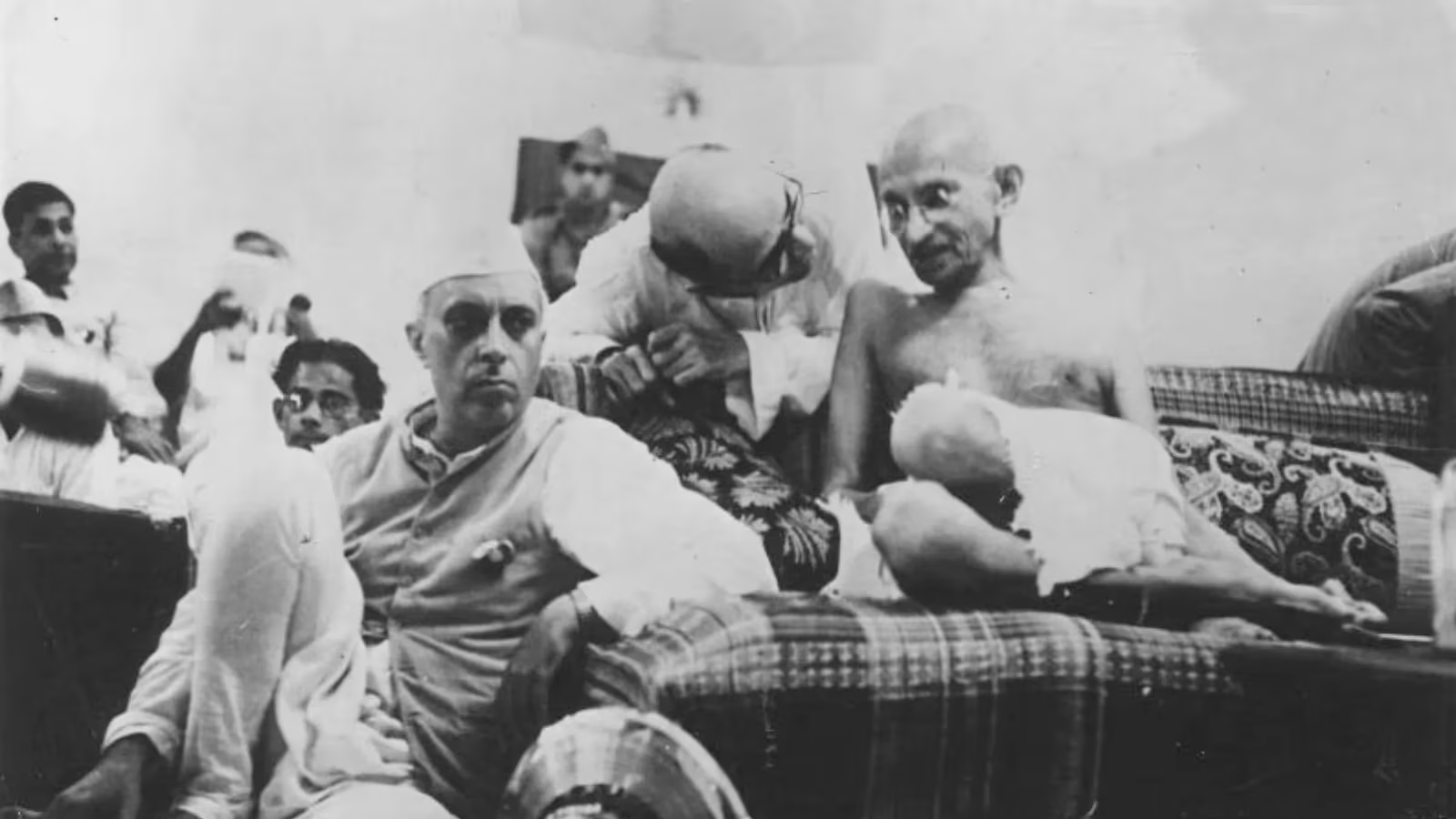
That loyalty to Gandhi, at the cost of a friendship with Bose which Nehru nurtured since the Lahore Congress session in 1929, was not based on any ideological convictions. It was motivated by the belief that Gandhi’s political patronage was necessary to rise in Congress hierarchy. Gandhi declared in a 1936 speech at Faizpur that “Jawahar will be my successor. When I am gone, he will do what I am doing now. Then he will speak my language too”.
But soon Gandhi, too, realised that Nehru wanted his political patronage but never shared his thought process. A telling exchange took place between the two in 1945. In a letter, Gandhi suggested that if the difference in outlook between the two was “fundamental”, the “public should also be made aware of it” as it would be detrimental to “keep them in the dark”. In his response, Nehru called Gandhi’s ideas expressed in Hind Swaraj “unreal” and bluntly told him that Congress “never considered that picture, much less adopted it”. But he pleaded for the matter to be left to the independent nation. His agenda was clear. He wanted people to believe that he was the political heir of Gandhi while hiding the fact that he was not the ideological heir.
In the end, Nehru’s only agenda in the last couple of years before independence was to ensure that power is transferred into his hands. In early 1946, elections to Congress president post were proposed. Whoever became the president would naturally have been the claimant for the prime ministership of the interim government going to be formed later that year. It is well known that twelve out of the fifteen PCCs proposed Sardar Patel for the post while none proposed Nehru. Yet he also threw his hat in the ring along with Kriplani and Patel. “No PCC has put forward your name” Gandhi told Nehru hinting that he may stand down. Nehru refused, forcing Kriplani and Patel to withdraw and hastily collect signatures of the Working Committee members in Nehru’s support.
Then came the partition challenge. Gandhi was determined to avoid it, but not necessarily Nehru and others. I wrote about it in the column last week. But there were opportunities in between. One such missed opportunity was the proposal of the Cabinet Mission in 1946. Known famously as the Cabinet Mission Plan, it envisaged arranging provinces into three groups: Group A would be the Hindu provinces, Group B would be the Muslim provinces of the Northwest and Group C would be the Muslim provinces of the Northeast. The central government would be limited to dealing with three subjects: defence, foreign affairs and communications and the remaining powers would be devolved to the provincial groupings. This arrangement, although opposed by Gandhi because it was a communal division, was accepted by the Congress Working Committee as it would have prevented partition allowing the British to transfer power to a united India.
However, Jawaharlal unilaterally called a press conference at the Congress House in Bombay, without the knowledge of any of the colleagues. He insisted that it was not to Congress’ liking that “we had a weak Centre”, and claimed that “the big probability is that, from any approach to the question, there will be no grouping”.
Jinnah was livid. He saw in Nehru’s statement a design to snub the League. He was in fact not happy with the plan right from the beginning. Nehru’s statement gave him an excellent excuse to wriggle out. He accused that the Congress leadership was insincere. An urgent meeting of the League leadership was called, and it was decided that the League would withdraw from the Cabinet Mission Plan.
Many Congress leaders were angry and upset with Nehru. Maulana Azad, who had just handed over the presidency of the Congress to Nehru, said, “Now happened one of those unfortunate events which changed the course of history… He (Jawahar Lal) is at times apt to be carried away by his feelings”. Sardar Patel called it Nehru’s “emotional insanity”. He criticised Nehru for acting with “childlike innocence, which puts us all in difficulties quite unexpectedly… and puts tremendous strain on us to set matters right”. Azad suggested that Congress should clarify that Nehru’s statement was his personal view. But Nehru reacted angrily saying that it would be an insult to him. The effort was shelved.
Then came the June 3 Plan, which was signed by Nehru and others without consulting the party ranks. In fact, the Congress leaders were so annoyed with the June 3 plan of partition that Gandhi had to personally intervene to pacify them.
That was what my column explained last week. Since the Congress leadership has a problem of comprehension, let me put it squarely – while Gandhi was driven by the desire to keep the country one, Nehru was driven by the desire for power.