

(The article was originally published in Indian Express on January 31, 2026 as a part of Dr Madhav’s column titled ‘Ram Rajya’. Views expressed are personal.)
78 years ago, on January 30, 1948, Nathuram Godse killed Gandhi for crimes that he believed the latter was responsible. Godse had several grievances that he enumerated before the special judge Atma Charan, who tried his case and punished him with a death sentence. Those grievances included Gandhi’s appeasement politics, fast unto death to get Indian government to release 55 crore Indian rupees to Pakistan, and fast to get a mosque in Delhi vacated by Hindu refugees who had fled from Pakistan. But the main grouse was that Gandhi had “acted very treacherously to the nation by consenting to the partitioning of it”. Godse believed that had Gandhi opposed Pakistan sincerely, neither Jinnah nor the British could have created it. He admitted that Gandhi “did undergo sufferings for the sake of the nation”, and “did bring about an awakening in the minds of the people”. Yet, “even this servant of the country had no right to vivisect the country”, he insisted.
That Godse was wrong in killing Gandhi goes without saying. But was Godse also wrong in his reasons for killing Gandhi?
Gandhi took inspiration from two prominent figures – Buddha and Jesus – for his principle of peace. Interestingly, all three met with unnatural deaths. Buddha died of food poisoning at Kushinagar at the age of 80. It was claimed that he knew that the food being offered to him by Cunda was contaminated and hence asked Cunda to bury the leftover without serving to any others while himself consuming it in order not to offend the host. In Jesus’ case Pontius Pilate, the Roman official, asked whether he was “the king of the Jews”, and Jesus’ reply was that “my kingdom is not this world”.
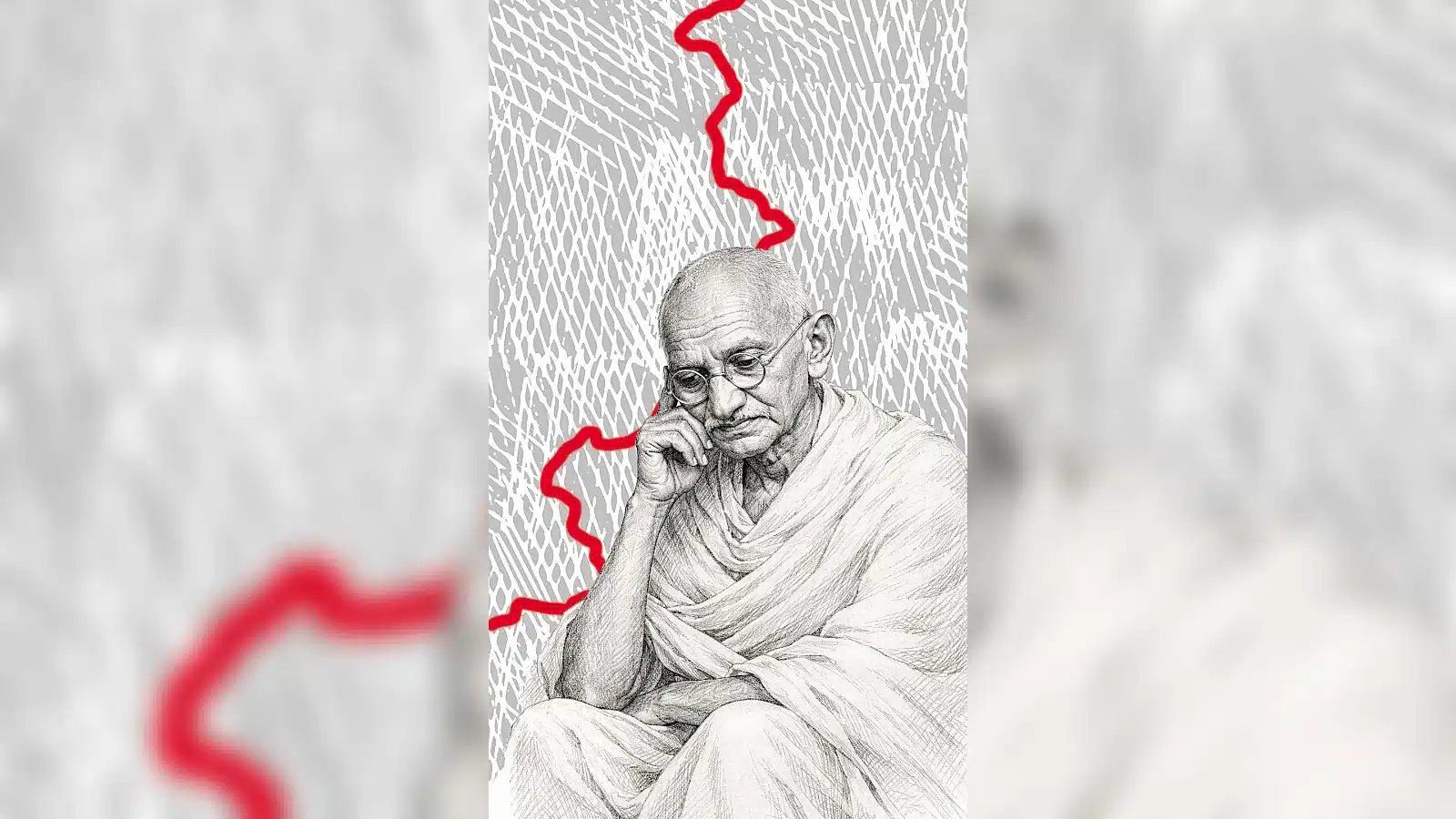
While Buddha accepted death because he didn’t want to offend his host, Jesus accepted death because his ruler didn’t understand him. In Gandhi’s case, the reason appears to be both. Gandhi never wanted India to be partitioned. “Vivisect me before vivisecting this nation”, he cried in anguish in 1940. But in June 1947, he decided to stand in defence of his junior colleagues who conceded partition. Gandhi repeatedly said he was against creation of Pakistan, but all his words and deeds failed to convince Godse who believed that Gandhi was cheating people of India.
Gandhi went up and down the stairs of the Jinnah House in Mumbai in 1945 to convince Jinnah to give up the demand for partition. It remained a futile effort. Things moved fast after that. The Cabinet Mission arrived in March 1946 and announced the proposal of dividing the country into three groups on purely communal lines.
Gandhi conveyed his opposition to this communal division when the Congress Working Committee met in June. But the Congress leadership, including Nehru, Patel and Azad, had by then made up its mind to accept the Plan because it was the first ever offer by the British to transfer power to them. Dejected, Gandhi left the meeting saying, “I admit defeat. I shall now leave with your permission. You should follow the dictates of your reason”. On earlier occasions, when Gandhi said something like this, the leaders would have urged him to stay with the promise that they would follow his instinct. But not that day. Pyarelal gives a graphic account: “A hush fell over the gathering. ‘What do you desire? Is there any need to detain Bapu any further?’ the Maulana Saheb asked. Everybody was silent. In that hour of decision, they had no use for Bapu. They decided to drop the pilot”. When the Working Committee met again at noon, Gandhi was not even invited. It gave assent to the Plan.
As suspected by Gandhi, the Interim Government remained dysfunctional due to the intransigence of the League. In desperation, Nehru, Patel and other Congress members turned to Gandhi again. Nehru went to Noakhali and requested him to return to Delhi. Gandhi refused and handed over a personal note to Nehru. “I suggest frequent consultations with an old, tried servant of the nation”, he pleaded.
Gandhi was aghast when he came to know about new Viceroy Mountbatten’s proposal in March 1947, with a definite indication of partition. He hoped that the Congress would reject it after consulting with him. Neither happened. In the Working Committee meeting held in the first week of March 1947, Congress demanded partition of Punjab on communal lines. Later, at a press conference at Madras, Kriplani indicated that the same principle could be applied to Bengal also.
The news of Congress recommending partition of Punjab agitated Gandhi. He wrote letters protesting the decision to both Nehru and Patel. A terse reply came on March 24. “It was adopted after deepest deliberation. Nothing has been done in a hurry or without full thought”, it said, adding, “It is difficult to explain to you the resolution about the Punjab”. “Such a thing would have been inconceivable in olden days”, rued Pyarelal.
Gandhi rushed to Delhi and in a desperate attempt to preventing the partition, met Mountbatten on March 31and proposed that the transfer of power over entire India could be done to Jinnah. Nehru and Patel were livid while Jinnah dismissed it as “one of those wily tricks of Gandhi”.
The new proposal for partition was presented by Mountbatten before the Indian leaders on June 2, 1947. Nehru, Patel and Kriplani were there from the Congress, while Jinnah, Liaqat and Nishtar represented the League. Sardar Baldev Singh was also called. Once those leaders agreed, Mountbatten did not waste time and immediately called a press conference to announce the partition plan, known as the “June 3rd Plan”.
Gandhi was faced with same dilemma that Buddha faced several millennia ago. Speaking to an agitated Congress leadership on June 14, he said that he was also opposed to the partition and had done whatever was in his hands to prevent it. He blamed the “circumstances” for his defeat. “Sometimes, certain decisions, however unpalatable they might be, had to be taken. Out of evil, sometimes good came out”, he contended before the audience.
Mood in the Congress session had certainly calmed down. When an enthusiastic member came to him saying, “Gandhiji, at last our non-violent army has won against the powerful British”, Gandhi wryly responded, “Yes, but it has also defeated and dethroned its General”. Disheartened, he withdrew from Delhi, refusing to attend the celebrations on August 15, 1947.
Gandhi cannot be completely absolved of his role in creating “circumstances” that led to the partition. But could he be singularly held responsible? Godse thought so, but the country did not. Indian politics, “in the absence of Gandhiji”, would surely be better, Godse opined. He proved wrong. India became a vibrant polity, but not in Gandhi’s absence but through his eternal presence.